Burn Ban in Effect. All outdoor burning is prohibited in Franklin County.



I have been around for over eight decades. I’m fortunate enough to have traveled to many parts of the world thanks to my military service. I’ve even briefly seen the interior of a brig….how this hero avoided a brig visit, is beyond me……
Lewis Millett deserted the U.S. Army to fight in World War II, then, years later, received the Medal of Honor from the same country that court-martialed him.
In 1940, Lewis Millett was serving in the Army Air Corps, and he was convinced America was going to sit World War II out entirely. He didn't want to wait around and find out. So he left.
Millett deserted, crossed into Canada, and joined the Canadian Army instead, determined to get into the fight one way or another. He shipped out to London, and once he got there, something changed everything: the United States officially entered the war.
Millett walked straight into the U.S. Embassy and transferred back into the American Army on the spot.
He fought hard once he got there, landing in North Africa, then Sicily, then Italy, earning a Silver Star along the way and climbing to the rank of sergeant. Then his past finally caught up with him.
The Army discovered his earlier desertion and court-martialed him for it, a charge serious enough that it could have ended in far worse consequences. He was found guilty, fined 52 dollars, and stripped of leave.
A few weeks later, the same Army handed him a battlefield commission and made him an officer.
That contradiction defined the rest of his career. After the war, Millett went home to Maine and started college, until North Korean forces crossed into South Korea and pulled him right back into uniform.
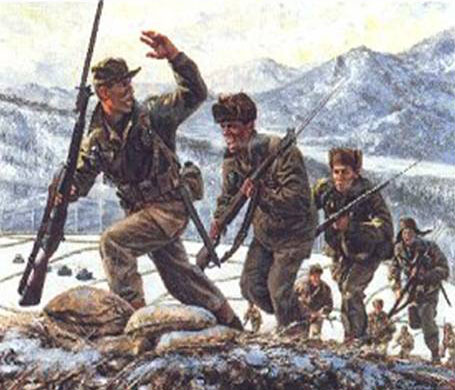
In February 1951, Millett's company was ordered to take a heavily defended hill near Soam-ni, Korea. One of his platoons got pinned down under heavy fire partway up the slope. Millett didn't wait for backup. He led a second platoon forward, merged the two groups together, and gave an order that most modern commanders would never give: fix bayonets.
He'd read captured Chinese documents claiming American soldiers were too afraid of close combat to fight hand-to-hand. Millett wanted to prove them wrong personally.
When the fighting finally ended, nearly half of the fifty enemy soldiers found on that hillside had been killed in hand-to-hand combat.
President Harry Truman personally presented Millett with the Medal of Honor in July 1951, for leading what's remembered today as the last major American bayonet charge in modern warfare. He also received the Distinguished Service Cross that same month, for leading a second bayonet charge just days later.
Millett went on to serve in Vietnam as well, completing a 35-year military career that included two Legions of Merit and four Purple Hearts.
A man once convicted of abandoning the Army ended up becoming one of the most decorated soldiers in its entire history, all because he simply refused to sit out a fight he believed in.