Burn Ban in Effect. All outdoor burning is prohibited in Franklin County.



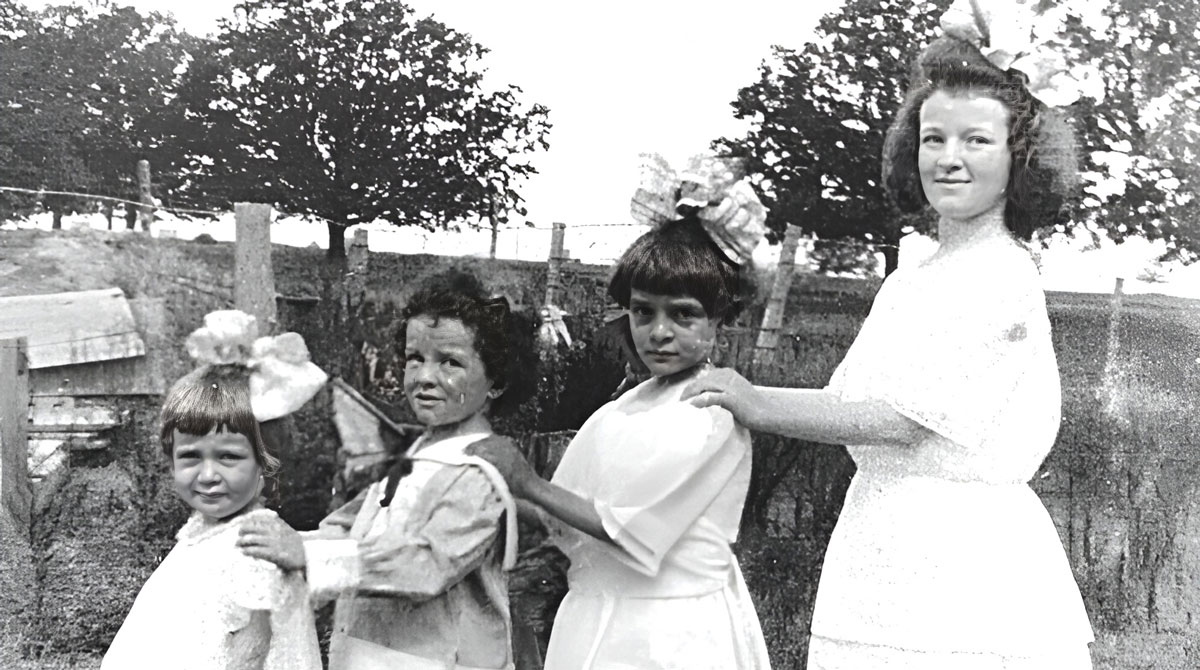
Photo above: Around 1918, the Hicks children are dressed up and posed, left to right, Nooney, Frank, Fay John, and Ivey.
One spring day a century ago, going west along the Bankhead Highway, my father and his sisters tramped the two miles home from school in Mt. Vernon. Near the end of their walk they heard an unfamiliar sound, coming from the old Indian campground southwest of the Hicks farm, on the slopes of Sweetgum Hill. The gravel-fall clatter of arrowhead-flint and pottery shards soon grew to a thunderous cascade. Hail, like an airborne horseback-warriors’ charge, tore young fruit from trees, flattened sprouting crops, stripped thickening stalks of corn, and drummed the highway bed.
The breathless, gaping children gripped their syrup-bucket lunch pails as hail stones, hurtling toward them, bounced off one another in the fields. Ivey, the eldest, gasped for air and yelled, “Put your buckets on your heads and run!”
Shielding the others, she hurried them along. “Mammy!” they cried as they flew onto the porch and into the dogtrot, tearfully encircling their mother. All were badly bruised.
May 26, 1922, The Mt. Vernon Optic Herald reported, “The hail storm did a great deal of damage in and around Saltillo. Crops and gardens were badly damaged and the roof of the Saltillo Hardware building was badly torn up and the rain ruined some of the furniture.” This was likely the same storm felt on the Hicks farm, four miles east of Saltillo.
Forty years later, I heard Aunt Ivey tell of that hail storm. Now, she and my other Hicks aunts expertly employed the cautionary tale, a genre exceptionally useful in the rearing of boys. My brothers and I thus took care not to eat toadstools, stick our hands into dark holes, and pet unfamiliar animals. And, at nine years old, I wondered, “Should I have a syrup bucket for my walks back and forth to school?”
Not long afterwards, Mother sent me on an errand to the NETCO store, which everyone in Mt. Vernon called the Ice House. Approaching from Smokey Row by foot, I heard a frightful racket, repeated, loud, and rapid: “Clack-clack-clack-clack! Clack-clack-clack! Clack-clack-clack-clack! Clack-clack-clack!”
It grew louder, coming down South Kaufman. Hailstones pounding in my head, I ran for the awning at Tillman’s Cleaners. But the Cargile and Jordan boys beat me to the corner of that building, storming round it on bicycles fitted with playing cards held by clothespins to the forks of their frames; and the cards flapped against the spokes to mimic a motorcycle’s sound. I leapt aside as they roared with laughter and rode away.
Well, let’s return to the year of that hail storm: On May 5, 1922, the Optic Herald carried a Mt. Vernon Light and Ice Company announcement: “Beginning now our ice wagon will cover the entire town each day. The price will be 70 cents per 100 pounds and 80 cents in any amount less than 100 pounds.” This company stored ice, for pickup or delivery, in a building at the northeast corner of the intersection of South Kaufman and the Cotton Belt Railroad tracks.
In time the NETCO store or Ice House would be located at this spot, occupying the south end of a new building shared with Tillman’s Cleaners. For reference, today’s Post Office sits there, beneath the downtown water tower.
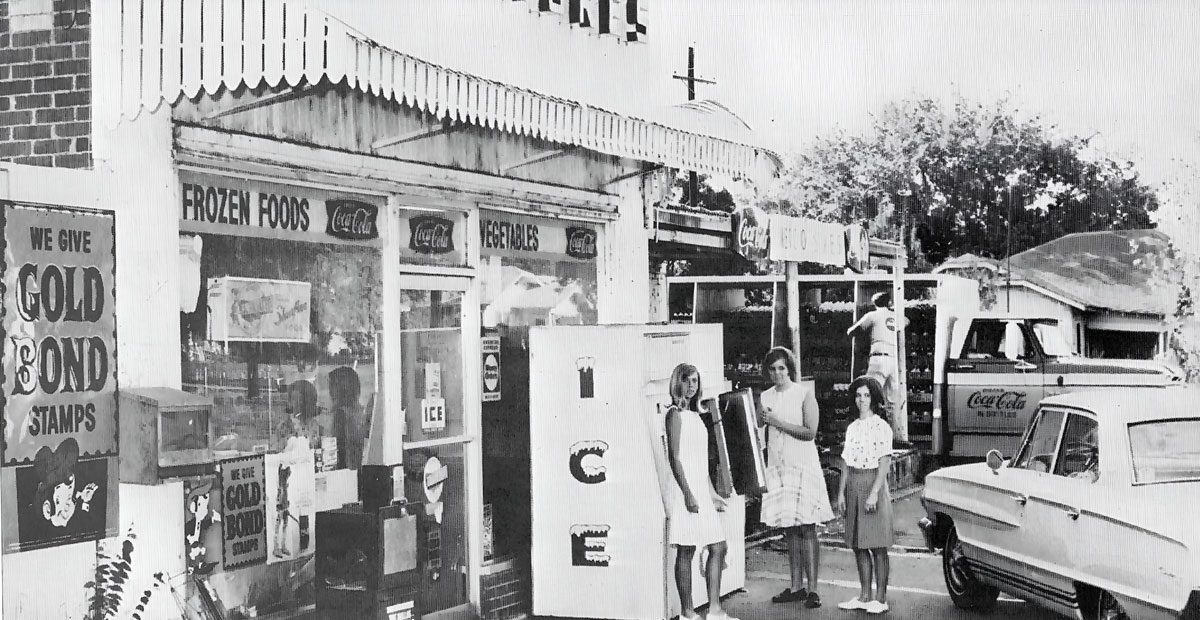
In his book, A Walk through Mt. Vernon, B.F. Hicks quotes Ray Loyd Johnson on the Ice House: “Before many places were air-conditioned, a hot summer day thrill for kids was to duck into the ice room.” And his schoolmates Kenneth Cason and Tommy Scott made deliveries of ice when Lem Cason managed the store (at least until 1958).
My own schoolmates will recall the NETCO store as run by Lineal Solomon in the 1960s and 1970s. Ford and Chevy pickups backed up to the store’s ice dock, where field workers and others would buy ice either cut into blocks or chipped. Other men my age will remember how high school boys filled water coolers with ice before spending long, blistering summer days hauling pickup loads of hay bales from field to barn. It did feel good to linger inside that ice-filled room. I seem even now to smell the fresh meat stored there and to hear the unforgettable ice-chipper’s roar, like that of Aunt Ivey’s ice-warriors storming down Sweetgum Hill.
This article is an excerpt from the author’s book, Bottomland Credentials.