

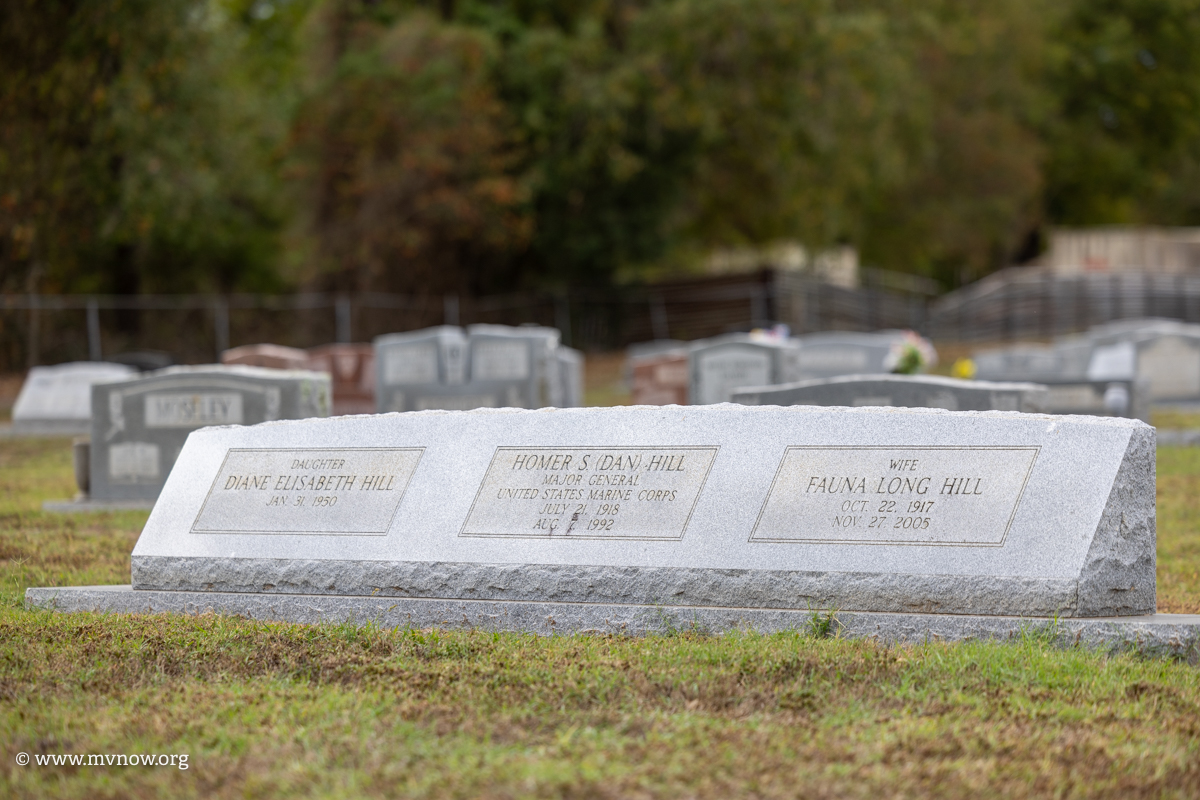
Homer "'Dan" Hill was born in the Franklin County community of Cypress on 21 July 1918. His father was Gary Lewis Hill, a small farmer and later a country store owner. His mother was Ivy Connelly Hill. His only sibling, Mary Ella (Hill) Boggess, was born September 21, 1921.
When he was 14, a barnstormer flew over the farm. Dan was hoeing persimmon roots when he saw the plane land about a mile away. He dropped his hoe and ran to see his first plane. That was when he knew he wanted to fly.
Dan started high school in Cypress, but in 1935, he moved to Mount Vernon High School. Coming from the farm, he had an Interest in agriculture. Influenced by his agriculture teacher, he became a Texas Lone Star Farmer and the National Vice President of the Future Farmers of America.
Dan also became a debater. At one debate, Nelva (Cowan) Seay introduced him to her best friend Fauna Long, daughter of Bob Long and Paralee (Cates) Long of the Majors Community. Dan and Fauna would eventually marry.
He would have graduated in 1936, but because of the Depression, he didn't have money for college. He continued to take classes and did road work to earn his tuition.
In 1937, he was admitted to Texas A&M. Finances meant he would have to graduate in three years. The first two years he worked at a gas station while he studied, but the third year, he gave up the gas station job to concentrate on his classwork. He paid for the third year with a loan from the Knights of Columbus.
During all this, he put on his Aggie uniform and hitchhiked to Austin to see Fauna Ruth, who was a journalism major at the University of Texas.
Dan graduated in 1940 with a degree in Agricultural Education. Following graduation, he and some other Aggies went to Austin, Minnesota, to learn the meatpacking business at Hormel. He and another Texas Aggie, Hardy "Tex" Hay, learned to fly in a Piper Cub on snow skies. Tex Hay would become his lifelong friend.
Everyone could see that World War II was coming. Dan left Minnesota and went to the Navy Recruiting Office in Shreveport, Louisiana. He signed up in the Navy V-6 Flight Program. Eventually, he started in one of the first classes at the Naval Training Flight School in Corpus Christi, Texas.
In April 1942, he was commissioned as a Marine 2nd Lieutenant Naval Aviator.
Though Dan and Ruth would be lifelong Baptists, they were married in Corpus Christi at the home of a Methodist minister.
It was a marriage that would last for 50 years—a true partnership. Dan once wrote, “The life of a Marine wife is truly a study in hope, dedication, faith, courage and fortitude. In this regard, Fauna Ruth Hill had it all, plus some. When she became a Marine Corps wife, they threw the mold away."
During 1942, the Marine Corps loaned some of its pilots out to American Airlines. Dan flew DC-3's to Central and South America. But by 1943, Dan was in the Pacific. He was flying transports B4Dn (DC-3s) with his fellow squadron members from New Caledonia into the Solomon Islands. The collection of transport squadrons was known as SCAT. At Guadalcanal, Marine transports flew emergency supplies and equipment in and the wounded out. These transports flew unescorted and unarmed.
After Guadalcanal, the transports flew as the Marines uncovered different Japanese bases in the Solomon Islands. At Bougainville, Dan flew the first Marine transport onto the island. During World War II, Dan received two Distinguished Flying Crosses and eight Air Medals.
In Spring 1944, he returned to the United States. At El Toro, California, he received his first command of a squadron. The RV-3 was a converted bomber meant to be part of the invasion of Japan.
Just a few days before they were to take off, the War with Japan ended in April 1945. His squadron flew to Hawaii, where they became an emergency supply squadron for the Marines in Japan and China.
At this time, Dan and his fellow transport pilots had to make the decision whether to stay in the Marine Corps or return to civilian life. Dan chose the Marine Corps.
In 1952, Dan was given command of a tactical fighter squadron, VMF 314. At first, they flew out of Cherry Point, North Carolina, but in late 1952, they moved to MCAS-Miami and began to fly the jet F9·F4 Panther. In June, 1953, the squadron received orders to go to Japan and Korea.
In Japan, he was transferred out of the squadron into Korea, where he served as the Assistant Operations Officer for the 1st Marine Air Wing.
In the fall of 1954, he left Korea to go to the Marine Corps Senior School in Quantico, Virginia. After graduating, he stayed in Quantico and became the Commanding Officer of AES-12, a fighter/bomber demonstration group to give Congressmen and Senators in Washington, D.C. an idea of the Marine Corps' readiness.
From Quantico, Dan and his family were sent to Pensacola, Florida, where he received two months of training as a helicopter pilot. Of all the aircraft Dan flew, he loved helicopters the most.
After training, he went to Santa Ana, California, where he commanded several helicopter squadrons, and then became the Operations Officer for the Group.
In 1959, the Commandant of the Marine Corps selected Dan as one of two officers to take helicopters aboard a Navy carrier. Dan was assigned to the Princeton on the West Coast.
The Princeton was a carrier from World War II with a straight deck. The other officer took helicopters aboard the same kind of carrier on the East Coast.
Because of his seniority, Dan also became the Flight Director on the Princeton. This was a first because the Navy had never had a Marine hold "such a Navy position aboard ship." He was responsible for all flight operations. The experiment with the Princeton led to the "mighty" LPH fleet that exists today.
After the Princeton, Dan and his family went back to Marine Headquarters in Washington, D.C. There he became Head of the Officer and Plans Branch of the Marine Corps Personnel Department. While there, he went to IBM in New York and took training that allowed him to set up one of the first computer programs for the Marine Corps, which dealt with selection and promotion of Marine Corps Officers. During this tour, he was promoted to Colonel.
The National War College in Washington, D.C. was set up for Colonels (of all the services), Navy Captains and members of the State Department who might become Generals, Admirals, and senior State Department officials who might become Ambassadors.
Dan was selected to attend this school. He called it a "rich and rewarding experience that broadened his horizons." Of 250 class members, one hundred fifty were from the State Department. Top people from Washington, D.C. came and spoke to the class. After the class work ended, each student went on a three-week visit to the region of the world in which the student might have an interest. Dan chose Africa to give him an idea of "the national and international challenges" that he might not have had.
After the War College, Dan and his family were ordered to Hawaii, where he would serve in FMFPAC (Fleet Marine Force of the Pacific) under Lieutenant General Victor M. Krulak, nicknamed "The Brut."
Dan assisted in planning for all the Marine forces in the Pacific. This included the buildup of operations in South Vietnam. For his work under Krulak, he received the Legion of Merit.
At the end of this tour, the Promotion Board in Washington, D.C. made him a Brigadier General.
Dan went to Cherry Point, North Carolina, and became the Assistant Wing Commander of the 2nd Marine Aircraft Wing. He was responsible to the Commanding General, Major General Hugh Elwood, for all the Wing operations. While in Cherry Point, in March 1968, he got "sudden death" orders to Vietnam.
In Vietnam, he became the Assistant Wing Commander of the First Marine Aircraft Wing. He worked in the northern part of South Vietnam along the DMZ. He flew to various bases to discover what Marine commanders needed from Marine Air Support and to coordinate that support. He also kept the Commanding General of the 2nd Marine Air Wing, Major General Ray Davis, in Danang advised.
After his 13-month tour in Vietnam was over in May 1969, he came back to Dallas, Texas, and then went on with his family to Washington, D.C., to become the Assistant Director of Marine Aviation under Major General Keith McCutcheon, one of the Marine Corps most brilliant minds.
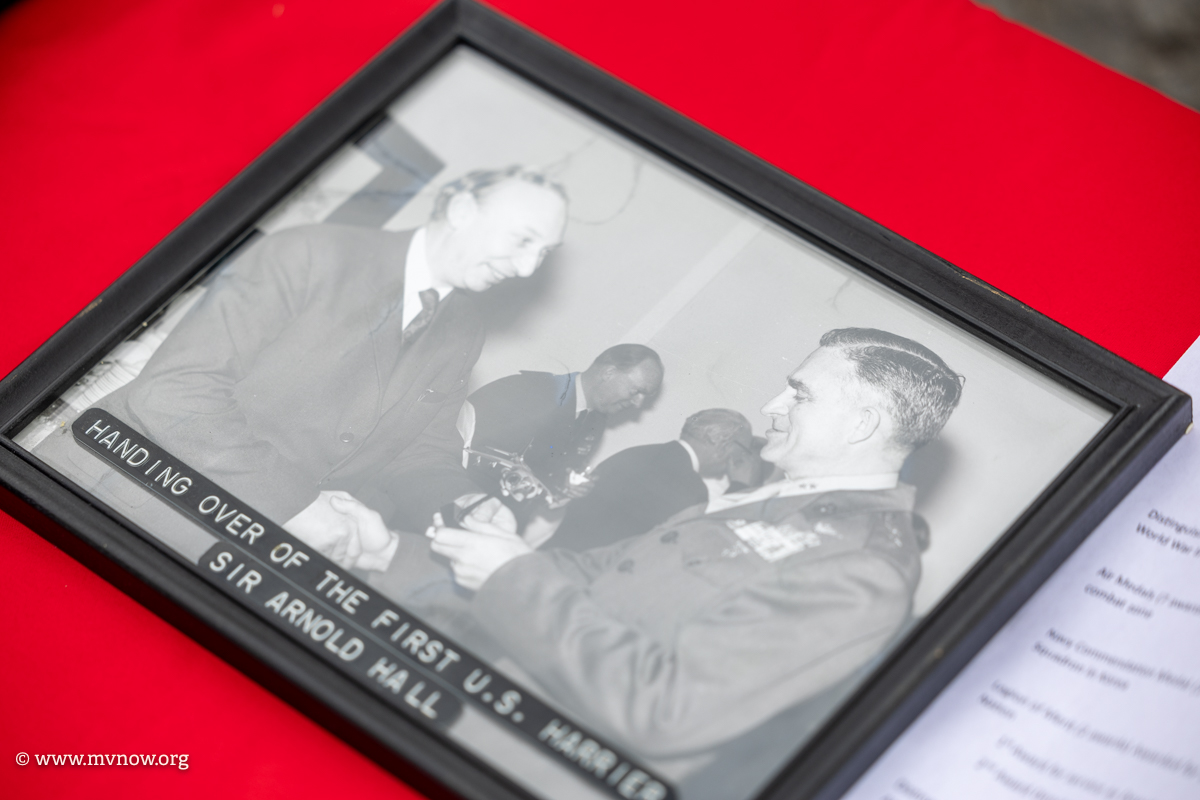
Major General McCutcheon started the Harrier program. The Harrier was a plane that took off and landed like a helicopter, but flew like a jet. After McCutcheon requested to go to Vietnam and to receive his third star, Dan became the Director of Marine Aviation and was promoted to Major General.
Director of Marine Aviation was the top post for an aviator. Dan became responsible for all Marine Aviation. It was the most arduous of any jobs he would hold. He worked 12- to 14-hour days, often including Saturdays.
Because the Harrier was made in Great Britain, Dan had to fight for it before Congress, giving special briefings to Senators and Congressmen. The Marine Corps got the funding and bought the Harrier.
To get funding for other Marine aviation projects, Dan had to fight with the Navy, the Defense Department, and Congress. At the time, he was able to acquire the heaviest Naval lift helicopter, the HR 25. He upgraded Air Control and Command Systems, and received money to keep Marine Air modern and ready. To do all this, he credited the assistance of his "very capable and hard-working staff."
Dan worked for two years as the Director of Marine Air. Then, he asked the Commandant of the Marine Corps to be assigned as the Commanding General of the 3rd Marine Air Wing at El Toro, California. He also became the Commanding General of the First Marine Amphibious Force. As the senior Commanding General, he became responsible for all the Marines on the West Coast.
El Toro was his last command. Dan asked the Commandant for retirement on 1 March, 1974 after almost 33 years in the Marine Corps. As he wrote, wryly commenting on every general's fate, “On March 1, 1974, I nothing.”
He and Fauna Ruth bought a house in Solana Beach, California, rented it, and then went home to Frankfln County. Texas to take care of their families.
Dan and Fauna Ruth spent the rest of their lives moving between Solana Beach and Franklin County
In the late spring of 1972. Dan had an emergency gallbladder surgery in La Jolla, California. During the surgery, the doctor found that Dan had pancreatic cancer.
Before beginning treatment. Dan, Fauna Ruth, and their daughter, Diane, flew to Nashville and then drove to Greenville, Kentucky, to see his mother, sister, and nieces.
On the flight, Dan developed a blood clot. He was admitted to Greenville General Hospital, where he died on August 7, 1992
After Dan's death, his La Jolla cardiologist wrote to Fauna Ruth that of all the Generals and Admirals he had treated, General Hill was the only one to take such Interest In the lives of the people around him both in the service and out.
An attitude. Dan had learned early while growing up in Franklin County. Texas
Semper Fl, Homer Dan
Distinguished Flying Cross (2 awards) For service and flight performances in combat during World War II in the South Pacific
Air Medals (7 awards) Additional flights in World War II in the South Pacific-not always in the combat zone
Navy Commendation Medal (1 award) For service as Commanding Officer, Marine Fighter Squadron in Korea
Legion of Merit (2 awards) Awarded for distinguished performance of duty and service to the Nation
1st Award for service as Deputy Assistant Chief of Staff, G-3, Fleet Marine Corps Pacific
2nd Award Director of all Marine Corps Aviation, Washington, D.C.
Distinguished Service Medal Awarded for service as the Assistant Wing Commander, 1st Marine Aircraft Wing, Vietnam 1986-69
Several Campaign and Combat Area Awards for combat service in WWII, Korea, and Vietnam, and Personal Letters of Commendation