Burn Ban in Effect. All outdoor burning is prohibited in Franklin County.



Let’s start this tale with my Aunt Ivey’s shopping spree.
In Willingham’s Variety Store, one might find almost any category of merchandise. Inventions of the late 1800s had brought innumerable innovations to retail venues around the country. I once asked my aunt, Ivey Hicks Smith, to help me build a setting for stories of Franklin County in the 1920s; and she described, among other things, some of those items she herself had found on display at the variety store.
In the spring of 1928, she searched for a gift. She would send it to an expectant mother, a former classmate at Mary Hardin Baylor. Aunt Ivey encountered an unexpectedly copious array of baby toys. Not a woman to be confused, she slowly considered her selection. Would her friend want a whistle-rattle or whistle-pacifier combination, a simple rattle or pacifier, or a teething ring?
Then Ivey saw that green rubber frog. It croaked and jumped when you squeezed a rubber bulb attached to it by a tube. Of course, you couldn’t let a baby itself grab the toy, but the sight and sound might well suspend a colicky baby’s cry. It would make a nice surprise in the mail; and Ivey would write her friend one of those beautiful letters! I myself have treasured her letters throughout the years, though I long ago lost my own rubber frog.
In what little was left of the Pre-Depression Roaring Twenties, Ivey had school-teaching money, not only for a toy but also for a lamp to help with work and study at night. On display at Willingham’s Variety Store she found various lamps: There were night lamps to carry in the house after dark, banquet lamps to set around a fancy parlor, library lamps in ornate brackets for office walls and public spaces, ceiling lamps to brighten big rooms, and floor lamps for topple-free locations.
Well, let’s talk about the coal-oil essentials of life in the 1920s.
Aunt Ivey, her sisters, and my father always called lamps with glass fonts “coal-oil lamps,” because they originally burned the hydrocarbon oil distilled from bituminous coal. But for most lamps used at the Hicks farm, my father would buy kerosene, a low-grade derivative of crude petroleum or shale oil. And he used the term “kerosene lantern” for any metal lamp used out of doors. Into the early 1960s, adults and children carried those on nighttime walks to the chicken coop, corncrib, smokehouse, and other outbuildings. We also carried the lanterns when fishing and frog-gigging after dark.
Every Christmas we Hicks boys expected stockings full of treats at the farm. One year, along with those, we found three small red kerosene lanterns. We carried them everywhere and somehow never set fire to anything except their wicks. I recall the pungent smell of burning oil and cotton, wafting up with ebony smoke from a hot glass chimney.
Occasionally my brothers and I tore fingers on rusty barbed wire and stepped on nails while playing around the farm’s outbuildings. Fearing tetanus, our aunts would then make us soak the affected appendages in antiseptic lamp oil. And, as we endured the soaking, Aunt Nooney would regale us with cautionary tales. With vivid and frightening images, she pictured men dying of lockjaw. Tied down on their beds, they foamed at the mouth and gnawed on spoons until they bit the utensils in two.
She and Aunt Ivey had actually seen the neck and jaw muscles of affected persons lock up with tetanus. An effective vaccine was tested on soldiers in World War II and adopted for widespread use only after 1948. Troublesome side effects were eliminated in a newer vaccine in 1991. We baby boomers and our progeny have gladly been spared the horrors of which Aunt Nooney told. I recall other tales of now-rare illnesses, primitive methods of treatment, and grisly surgical procedures performed without anesthesia under the light of a coal-oil lamp.
Years after Aunt Ivey’s shopping trip, coal-oil and kerosene lighting remained essential in the homes, schools, churches, and stores of Franklin County’s many rural communities. Meanwhile, privately owned companies in Northeast Texas had been producing electricity by steam and water-driven generators since 1900. Electric lighting had come to downtown businesses in Mt. Vernon in 1906. In our featured year of 1928, both electricity and natural gas came to the town’s homes and public institutions.
In 1935 the Rural Electrification Administration would spur the formation of electric cooperatives and bring wiring and power to farms and ranches in many places. Rural areas of Northeast Texas slowly experienced this development. Only in 1946 would the areas outside our town begin to have light bulbs hung by cloth-wrapped copper wire from the twelve-foot ceilings in homes like those at the Hicks farm.
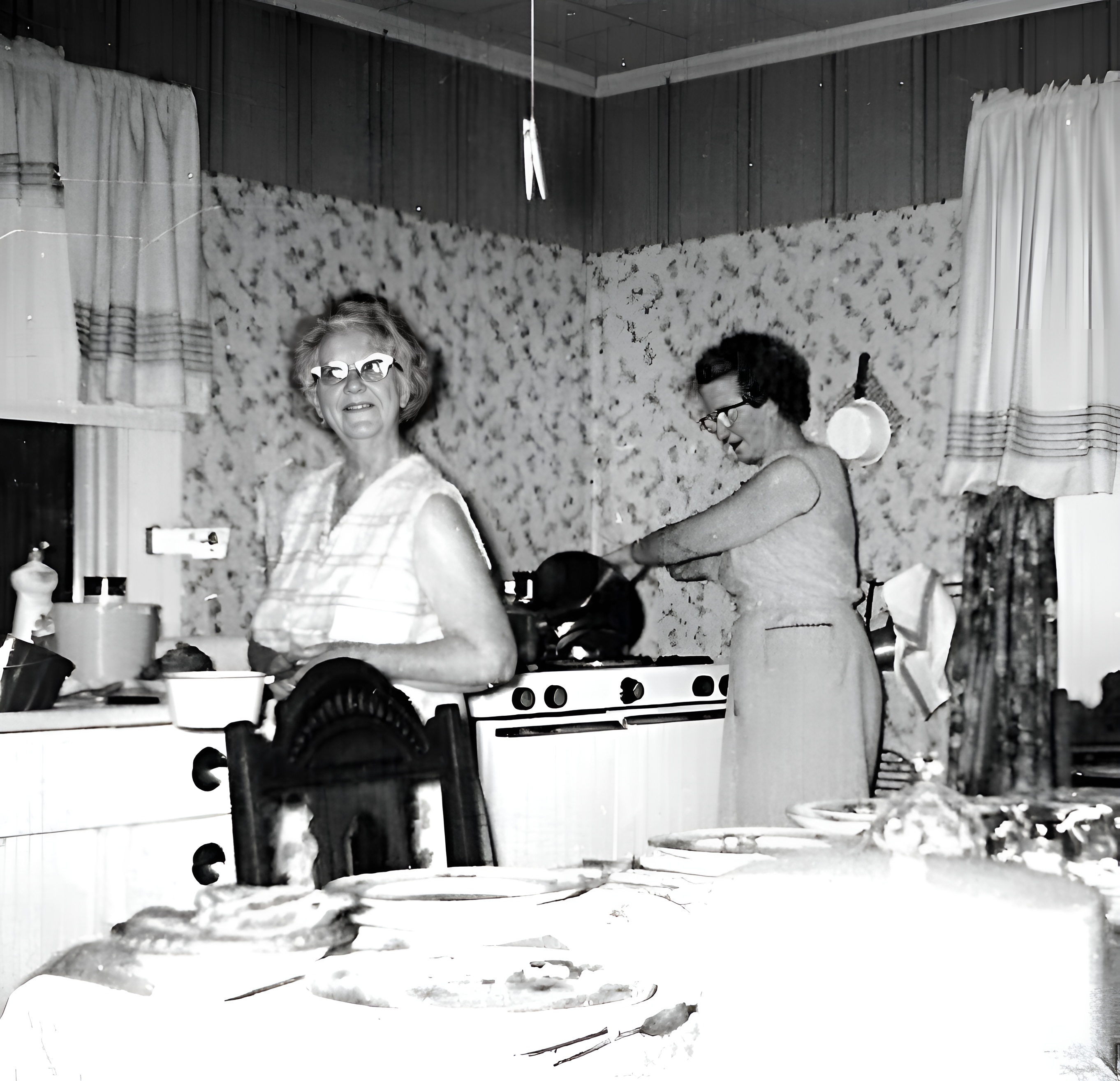
In one interesting Hicks family photograph, a clothespin hangs midair above a kitchen table. The wooden clip served as a pull-switch for a socket hung three or four feet below the ceiling. From there one incandescent bulb lighted the whole room. Aunt Ivey, in the background of that picture, helps to prepare a meal; and my brother B.F. identifies the other woman as our Great-Aunt Mattie Kate Veazey (youngest sister of our grandfather, John M. Hicks). In the summer of 1960, my brother went with our father and our Hicks aunts for a visit at the Veazey home in Choudrant, Louisiana.
This article is based on Chapter 17, “A Clothespin Pull,” in the author’s book, Bottomland Credentials.