Burn Ban in Effect. All outdoor burning is prohibited in Franklin County.



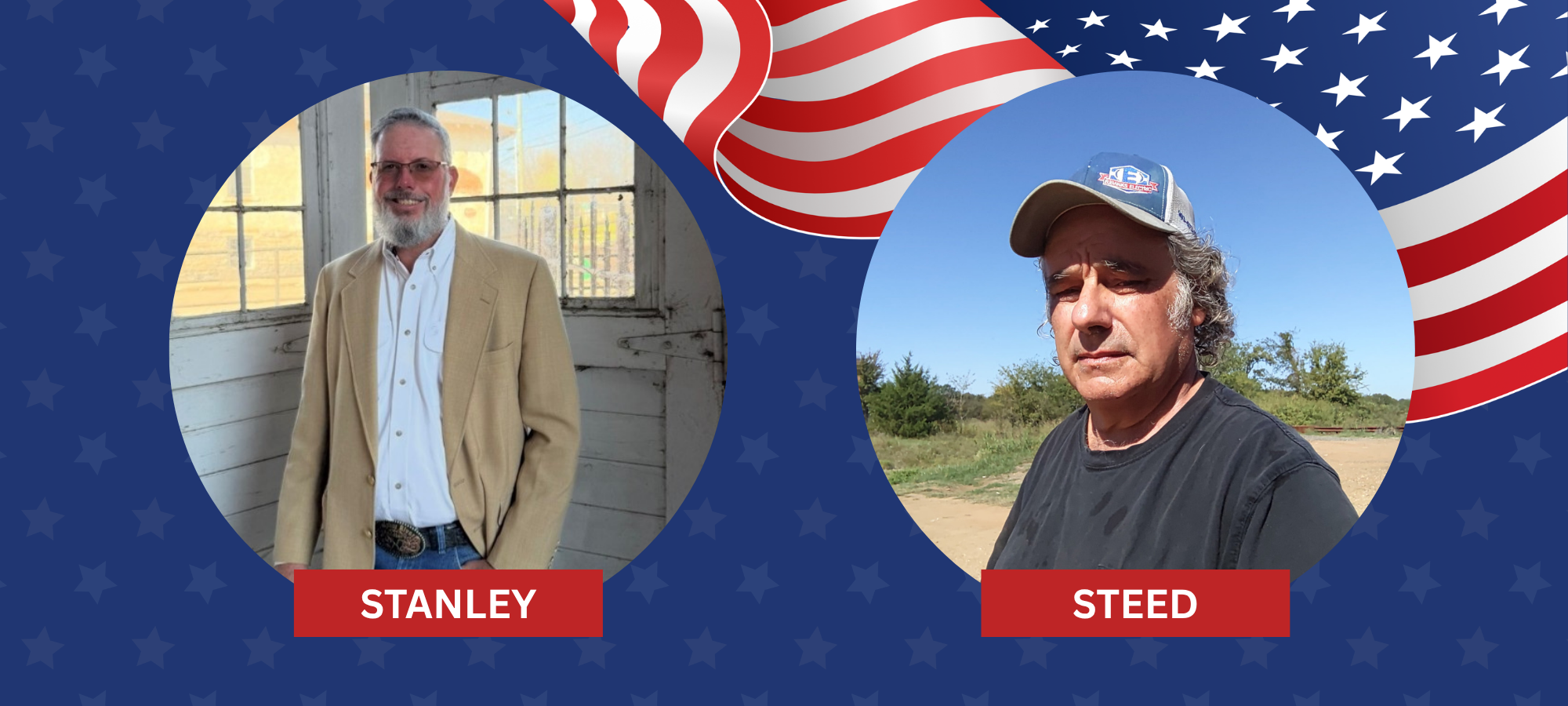
Members of the local public submitted questions to be posed to the two candidates for Commissioner Pct 1, Franklin County, with responses being published here on May 17. This is done for information purposes and to remind those voters living in Commissioner’s Pct. 1 that early voting begins Monday, May 18, and continues through Friday, May 22, 7 a.m. to 7 p.m. at the Franklin County Annex East, 502 E. Main St., Mount Vernon, TX 75457.
The concerns raised in each section appear at the start of responses from the two candidates. To be fair, we rotate back and forth between the candidates as to which response is first in each of the sections. To ensure which candidate the response is from, JS=Jody Stanley and RS=Ricky Steed.
Editing from some original submission text was done by the candidate to meet the 125-word limit for responses. Candidates may choose to answer additional questions or provide a more extended response on their social media sites, which are easily found via search on various media platforms.
JS: Every county experiences growth and the challenges that come with it. In Franklin County, city and county leaders must work together to manage growth while preserving the character of our small rural community. That is one of the main reasons I want to serve as County Commissioner. I’ve seen significant change in recent years, with even more ahead. Precinct 1 is the county’s most rural area, home to farmers, ranchers, families, and neighbors who value country living. Yet a few landowners are making decisions that impact the entire community. Citizens misunderstand that the commissioner’s court doesn’t create laws, but as commissioner, I want to be a voice for the majority and help bring growth and community values together through practical solutions.
RS: Responsible spending is the most important issues facing Franklin County. As we grow, we must prioritize needs over wants, use taxpayer dollars wisely, and make decisions with transparency, accountability, and common sense. Smart budgeting allows us to maintain essential services, support public safety and emergency services, and encourage economic growth without placing unnecessary burdens on citizens. I want to prepare Franklin County for growth by supporting small businesses, protecting family values, preserving agricultural roots, and being thoughtful about development such as large-scale solar projects. Growth should not come at the cost of family land, water resources, or our rural way of life. Commissioners must also operate within Texas law, balancing community needs with legal responsibilities while listening to citizens and planning for the future.
RS: One of the biggest financial risks facing Franklin County over the next 5–10 years is the rising cost of road maintenance, equipment repairs, materials, and drainage issues. Counties must maintain infrastructure with limited budgets, so responsible spending and careful planning are critical. I believe budgets should account for rising costs while still protecting taxpayers. When citizens want better roads, lower taxes, and more services, we must prioritize needs, focus on essential services, and make repairs correctly the first time instead of relying on temporary fixes. Proper equipment maintenance, quality materials, and a clear repair plan based on safety and severity will stretch taxpayer dollars further. Improving drainage and ditch maintenance will also help prevent erosion, washouts, road damage, and costly future repairs.
JS: I believe the biggest financial risk facing the county, especially Precinct 1, is maintaining county roads as traffic increases from energy development. Rising costs for materials, fuel, equipment, and labor make it critical to hold energy companies accountable through fair solutions like “Road Use Agreements” to reduce the burden on taxpayers. Preventive maintenance is key to saving money. Simple upkeep, such as patching potholes, improving drainage, and trimming limbs, helps extend the life of all 88 miles of county roads and avoids costly reconstruction. I also believe the county can operate more efficiently by using practical, common-sense solutions, such as reducing unnecessary hauling distances (like hauling brush from one end of the county to the other) that waste fuel, labor, and equipment resources.
JS: The county can support growth and improve quality of life by maintaining roads, ensuring proper drainage, cleaning culverts, and reducing trash along county roads. Small improvements, like fixing potholes near driveways, make a difference for residents. The county should consider placing trash receptacles (like Sonic) at major intersections to help reduce litter. Balancing economic development with private property rights is challenging because both matter. The county should welcome responsible companies that create jobs and generate tax revenue while also protecting farmland, water resources, neighboring properties, and the rural character of the community. The goal is not to automatically approve or block development, but to ensure growth aligns with the values and interests of the people who already live here while planning responsibly for long-term stability.
RS: The county can encourage growth and improve the quality of life by supporting small local businesses, reducing unnecessary barriers, and investing in roads, drainage, bridges, and emergency services. Growth should create jobs and strengthen the local economy without harming agriculture, water resources, family lands, or the rural character of Franklin County. I believe in protecting private property rights while also considering how large developments, such as solar projects or outside interests, may affect neighboring landowners, infrastructure, and natural resources. The county must also be willing to make difficult long-term decisions, including courthouse improvements, lake infrastructure repairs, and budget adjustments for rising maintenance costs. By planning ahead, prioritizing essential needs, and spending responsibly, we can protect taxpayers while preparing Franklin County for future generations.
RS: Transparency and accountability under my leadership would go beyond complying with the Open Meetings Act. It means maintaining open communication, being visible and accessible, and making sure citizens understand what projects are being addressed, how taxpayer dollars are being spent, and why decisions are being made. I believe accountability is shown through action — the proof is in the pudding. Residents should be able to see progress on long-overdue tasks, infrastructure improvements, and responsible use of county funds. I will provide clear, timely updates through public meetings and direct communication when concerns arise. County leadership should be approachable, honest about challenges, willing to listen, and committed to following through on promises. Keeping citizens informed builds trust, encourages involvement, and ensures accountability to the people we serve.
JS: If elected County Commissioner for Precinct 1, I will encourage transparency and accountability by creating a Facebook page called “Precinct 1 of Franklin County.” I plan to post weekly updates about road work, county projects, upcoming plans, and decisions that affect residents. I also want the page to serve as a way for citizens to share concerns, ideas, and feedback so their voices are heard. Open communication is important, and I believe residents should know what is happening in their community and how county resources are being used. My phone number would also be publicly available on the page so anyone can contact me directly at any time with questions, concerns, or suggestions.
JS: County and city-connected roadways, and responsibility for maintaining them, can sometimes be unclear, but communication with the city is the first step toward finding solutions. Addressing shared roadway concerns would be a priority for me, especially issues like erosion, drainage problems, and the poor railroad crossing on Carr Street and County Road 1011, along with concerns on Yates, Kaufman, and other shared roads. I would work closely with the city in any way possible to improve safety and travel for residents. When determining which roads or projects receive priority funding, decisions should be based on traffic volume, the number of residents affected, and overall road condition. The roads in the worst condition that impact the most people should receive the greatest attention and funding priority.
RS: To properly address deteriorating roads such as Yates and Kaufman, we must first fix underlying infrastructure issues like failing sewer lines and drainage problems before spending taxpayer dollars on major road repairs. Resurfacing before underground work is complete would only damage the roads again and waste money. I believe in fixing problems the right way the first time through careful planning and coordination between the county and City of Mount Vernon. By maintaining open communication, sharing resources when possible, and creating coordinated repair schedules, we can address railroad crossings, street maintenance, and drainage concerns more efficiently. Priority funding should be based on safety, traffic volume, school bus routes, emergency access, severity of damage, and long-term value to ensure taxpayer dollars make the greatest impact.
JS: If elected, my first 180 days as County Commissioner will focus on listening, learning, and taking action. I plan to work closely with the road crew to understand current needs before beginning a precinct-wide maintenance effort addressing potholes, drainage and erosion issues, dead trees, blind corners, and overgrown limbs. The summer months would provide the best opportunity to complete much of this work. I believe in leading by example, both in the office and alongside the crew in the field. While balancing public opinion, financial limits, and long-term county needs can be challenging, I will remain focused on practical, conservative decision-making that benefits residents. I believe a commissioner should be respectful, transparent, hardworking, and committed to common-sense problem-solving while responsibly managing the county budget.
RS: My top priority during the first 180 days as Precinct 1 County Commissioner would be to assess roads, drainage systems, equipment, and ongoing projects while building strong communication with residents and county employees. I would identify urgent infrastructure needs, especially high-traffic roads and school bus routes, and create a practical plan based on safety, long-term value, and responsible spending. Improving ditch and drainage maintenance would also help prevent erosion and costly road damage. I believe a commissioner should lead with integrity, accountability, communication, and a strong work ethic. Decisions should be based on facts, priorities, and what benefits the greatest number of people. I will be visible, approachable, focused on employee safety, and committed to following through for Precinct 1.
RS: Ricky Steed was born and raised in Franklin County, living here his whole life, 66 years. After graduating from Mount Vernon High School, Steed went to work for Luminant Energy, where he worked for 37 years, running heavy equipment. He then served as Franklin County Maintenance Director for 4.5 years. He and his wife Judy have been married since 1984.
JS: Joe Dan “Jody” Stanley was born at the Franklin County Hospital in Mount Vernon and raised on the Smith Trust Ranch, located in Franklin County’s Pct. 1. He is a 1993 graduate of Mount Vernon High School, followed by “Stanley University of Hard Knocks,” he jokes. He owned and operated Stanley’s Store, the Sulphur River Saddlery Inc., and SRS Auction Services, based in Franklin County. The store was sold many years ago; however, Stanley still owns and operates the other two. With almost 52 years of life spent in the same area, Stanley said, “My entire family has been in Franklin County for generations, so this is definitely my home, my family, my community, and my county.”
Photos provided by the candidates.