Burn Ban in Effect. All outdoor burning is prohibited in Franklin County.



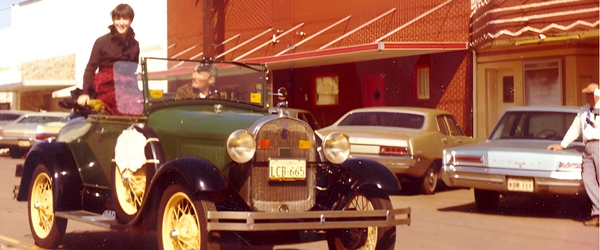
Photo Above: A parade passes by the Joy about 1970.
Hoofs aloft in the dust-filled air, mane swept back, and nostrils flared, the horse seemed frozen in the midst of its gallop. Ordinarily, the waking mind grasps a sequence of things perceived much as a walking man sets one foot down and lifts the other, anticipating solid ground. But now, for one bewildering, frame-stuttering moment, ordinary mental operations ceased; and, well, there was no “next.”
Then, with a cowboy-knight in its saddle, the animal rushed ahead at the boy. “Aiyeeeee!” an eight-year-old Frank Hicks screamed and ducked his head. A second later, he opened his eyes to see the valiant Tom Mix tearing off in the other direction. For the rest of his life, my father would remember this startling introduction to a phenomenal innovation, modestly named by many at that time “moving pictures.”
That day in 1920 on South Kaufman, the Hicks siblings saw “The Texan,” a humorous black-and-white silent Western. Along with all Mt. Vernon’s children, they soon came to appreciate big-screen action and patronized hometown picture shows for decades to come.
First in the U.S., Pittsburgh’s Nickelodeon debuted its fifteen minutes of flickering shadows on white sheets on June 19, 1905, and enterprising spectators everywhere perceived financial opportunity. Local historian Doris Meek uncovered tax receipts for paid admission to local shows as early as 1919. Her grandparents, Alter and Lillie Barrett, brought early silent films to Mt. Vernon. Mr. Barrett turned the reel by hand, film exited the projector into a tow sack below, and his wife played guitar and sang. By the late 1920s, my mother’s sister, Virgie Beth Hughes, was going to “talkies” on the square’s east side. And Fred Barker, born in 1922, recalled an open-air downtown theater.
Even earlier, as R.T. Wilkinson, Jr., recalled, the Queen Picture Show opened south of the square in 1910. On Houston Street’s east side, this was a long-lived and popular attraction owned by Theo and Mildred Miller. A story in the Optic Herald, December 1, 1922, publicized Ruth Roland’s serial “The Timber Queen,” which was shown there every Friday night and Saturday afternoon. Each episode ended with the star in peril, leaving fans in suspense and eager to return for the next. Saturday night brought a “complete change of program,” sometimes a musical performance by an orchestral ensemble.
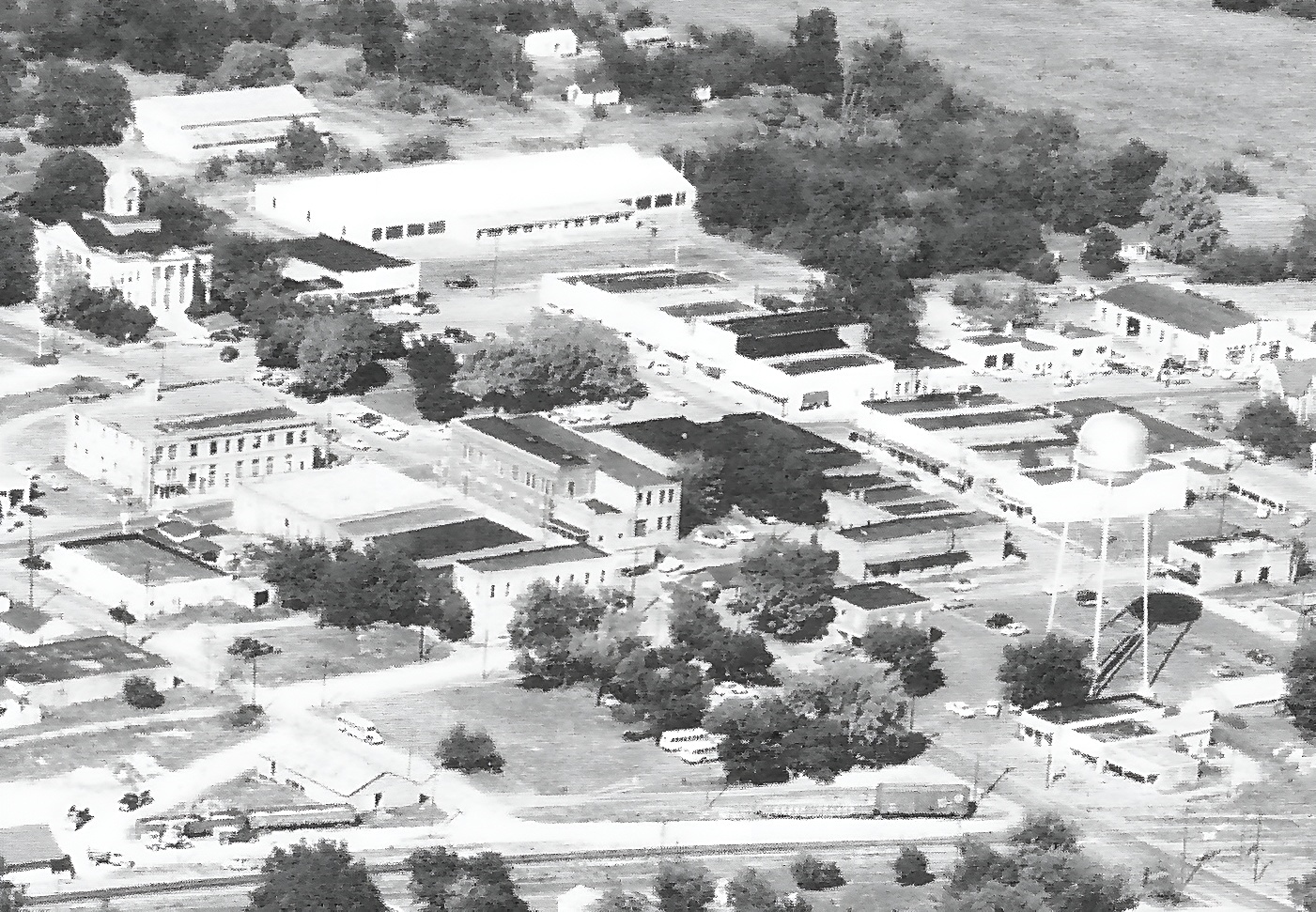
South of Main, Houston Street ended at the railroad, where three blacksmith shops repaired wagons, farm implements, and railroad equipment well into the 1950s. At the intersection with Main, on a day with a southerly wind, shoppers could see and smell fumes from coal-fired forges along the tracks. South Houston, nicknamed “Smokey Row,” bustled with excitement, but theatergoers might have preferred fresh air. When T.M. Hasty, owner of the Hasty Courts motor inn, later ran the Queen, he shrewdly remodeled a building uptown. Sam Harvey and Fred Barker both recalled, for B.F. Hicks’ book, A Walk through Mt. Vernon, describes how Mr. Hasty closed the Queen and opened the Joy on the square’s east side in 1939.
After operating for a decade, the Joy expanded so as to have, for white patrons, one entry leading into the lobby of a large lower floor and, for African-Americans, a southern side entry up a stairway to balcony seating.
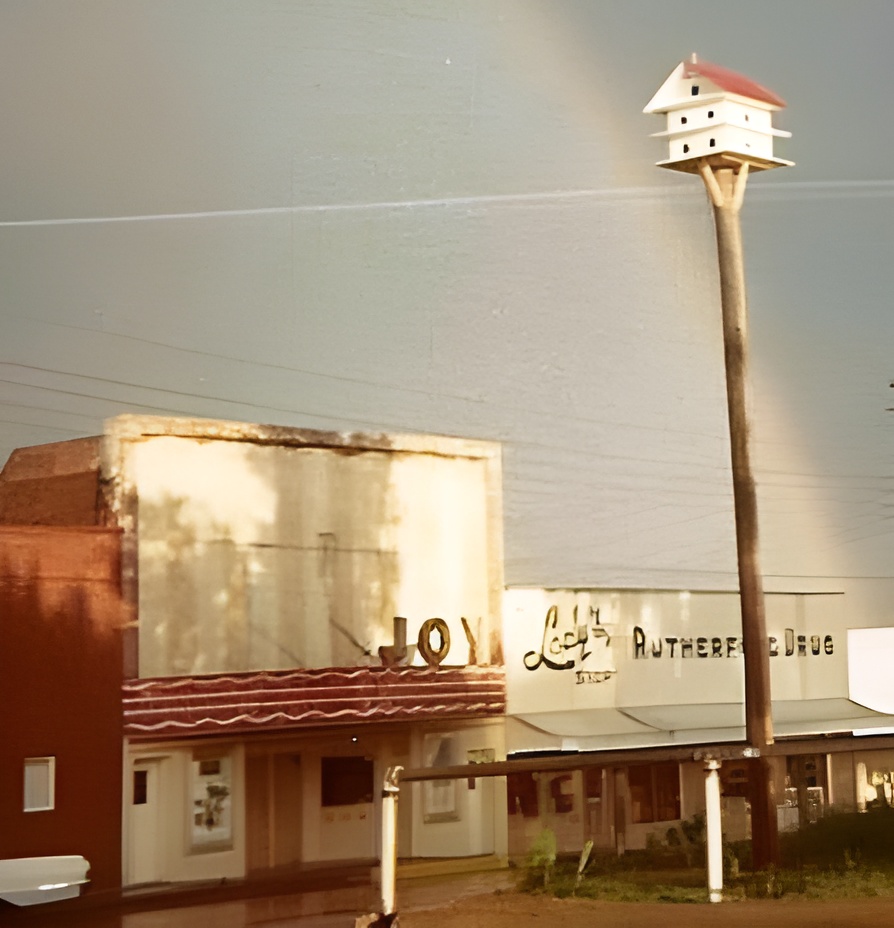
Roy and Myrtle Deviney later bought the Joy from Mr. Hasty. When Roy died, Myrtle married Raymond Young; they ran the theater but sold it in 1973. On reading a first draft of this article, Jaletta Farmer recalled two years of serving up popcorn, Cokes, and candy at the refreshment counter for the Youngs, “wonderful, sweet people.” The Joy, she recalled, showed evening features Thursday through Saturday; and there were matinees Saturday morning and afternoon and Sunday afternoon. She remembered displays in outside poster frames; recalling pictures from “Easy Rider,” she said, “I wished I hadn’t thrown them away.”
Unfortunately, the Young's sale presaged disaster. That fall, hanging out on the square, I watched with friends as the last of our hometown picture shows burned; I winced with shock as its awning fell. Telephones rang to summon volunteer firefighters, and their wives then dialed neighbors to spread the news. Ron Barker told me he got a call, then rushed with his wife, Sue, to join onlookers uptown.
In his book Reflective Rays, Ray Loyd Johnson eulogized the Joy. In the 1940s, when he was under twelve years old, he paid twelve cents for admission to Saturday afternoon serials and Sunday afternoon features. He bought popcorn for a nickel and enjoyed an escape from summer heat in air-conditioned comfort. Comic shorts like “The Three Stooges” and “Little Rascals” preceded the feature (as did the animated “Looney Toons” I remember from my childhood).
Adventure, mystery, and romance swelled the Joy’s marquee. But, as Mr. Johnson put it, “Boys liked cowboys.” Classic Westerns made a lasting impression. Eyes once glued to the Joy’s silver screen still pop wide as a horse and white-hatted hero hurtle straight ahead, as if to hurdle the TV frame and charge right into the home-theater den.
This article is an excerpt from the author’s book, Bottomland Credentials.