Burn Ban in Effect. All outdoor burning is prohibited in Franklin County.



Since May is ALS Awareness Month, the following are some facts you may not know.
I just completed year 3, starting year 4 since my diagnosis. I can no longer walk, talk, or eat regular foods, but although I chose to move to assisted living, I receive no personal services except meals, room cleaning, and laundry. I can still shower, dress, feed myself, feed and walk my dog, water my plants, play (and win) games, read, work jigsaw puzzles, go shopping and out to eat, attend athletic events, go to church, and type!

I started using a wheelchair full-time 6 months after my diagnosis. I started having noticeable difficulty eating and talking by the end of the first year, and by the end of the second year, I could still eat soft foods, but mostly only those who were around me a lot could decipher my words. Those people are my heroes because losing my voice has been by far the most difficult challenge I have faced.
I have learned to communicate by typing into a program on my phone that reads the words out loud or can be read by the person I want to “talk” to. That requires patience by the other person, as it takes a minute to type my message. I also have an Eyegaze tablet that I was given by my ALS group out of Dallas. It will help me answer my phone and have conversations with others as I get a little better at using it. It can also be set up to type with eye movement if I lose the use of my hands. There are some really good YouTube videos that demonstrate the Eyegaze tablet.
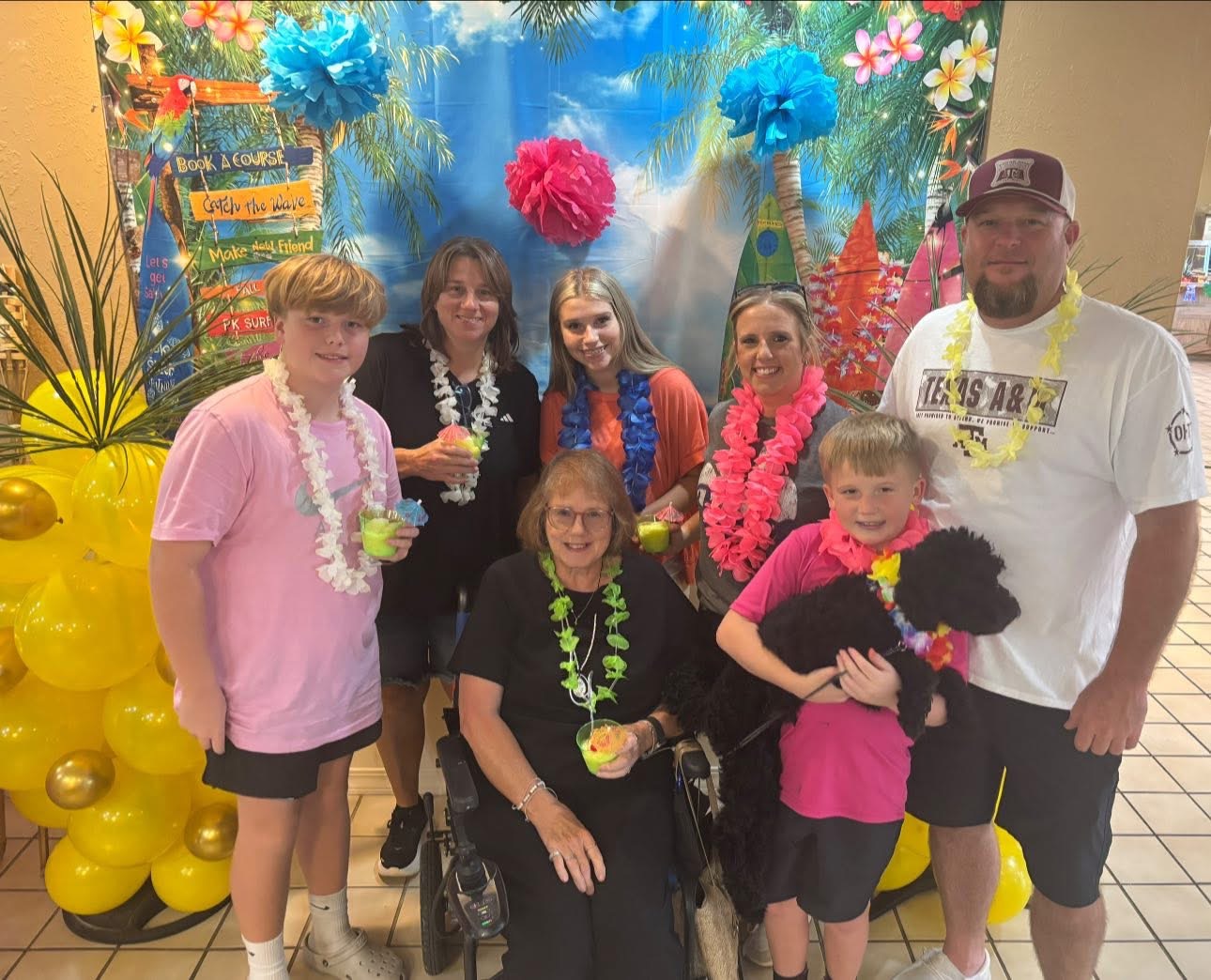

With every new stage of my ALS, I would just have to stop and spend some time making adjustments to be able to do the things I wanted to do. When I had to go full-time in a wheelchair, I traded my car in for a handicapped van with a ramp that let me drive my wheelchair up, transfer to the driver’s seat, and drive as usual.
When I started having trouble swallowing food, I changed my diet to softer foods, and I researched high-protein foods to help retain the muscle strength I need to do even the simplest of tasks. I even added some protein drinks to make sure I was getting the 95 grams of protein the dietitian said I needed.
My shower at the time had a step up, so I had to remodel my bathroom to make it more accessible. I rearranged drawers and cabinets to put the things I used more often in places easily reached. I had to have a ramp to get in and out of the back door.
I seemed to have found an answer to most everything, except how to accept the loss of speech. Typing messages on my phone or Eyegaze tablet helps, but it doesn’t take away the frustration of being silent when I so want to say something. Then this week a friend said they had listened to Ted Koppel interview Morrie Schwartz (from Tuesdays With Morrie by Mitch Albom), and she thought I might want to watch it.
It was, of course, a great interview but also a very emotional one. Koppel actually interviewed Morrie three times, the third being shortly before Morrie died of ALS. Morrie actually gave me the answer I had been looking for about how to deal with the silence. When Koppell asked Morrie how he would feel when he lost his speech, Morrie said, “I’m not sure, but I think I will find a way to make the silence speak. After all, there are other ways to communicate without speech.”
Fortunately for Morrie, he died before he lost his ability to speak. He had lost total use of his legs and his hands, but he could talk to the end. Fortunately for me, Morrie set my mind at ease. He went on to say he would tell his friends and family to try to word their questions so he could answer yes or no, and then to read his face to get lots of answers. Mostly, he would just enjoy the silence.
I think I, too, will just make up my mind to enjoy the silence.