Burn Ban in Effect. All outdoor burning is prohibited in Franklin County.



For the 1907-1908 school year, forty distinct schools operated in Franklin County. Let’s not forget that, but records of demographic change and school consolidation will serve for other articles. Let’s look for now at schools in our county-seat town.
A promising young man named Joshua Foster Johnson came to Texas from Tennessee in 1845 and settled near Mt. Vernon. Elected at twenty-five, he became our representative to the Third Texas Legislature and successfully sponsored the Mount Vernon Male and Female Academies Bill in 1849. The two schools came under a single roof in 1861.
The book Early Days in Franklin County includes my classmate Robert S. Long’s 1986 study of Franklin County schools. He located the 1861 school a thousand yards south of our current downtown square and east of Fannin Springs. B.F. Hicks assigns that name to “a spring on the east side of the intersection of Holbrook and Rutherford Streets.” Mt. Vernon was merely a trading center in that area prior to 1849, when “the town as we know it was laid out in lots.”
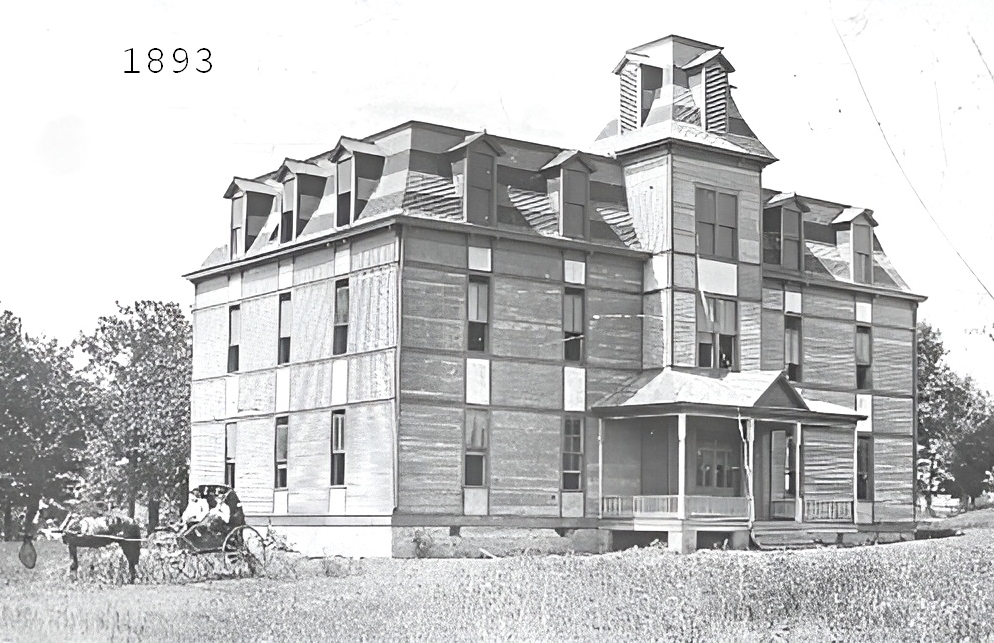
In 1893 a new school, the Franklin Institute, represented a significant investment in public education. Built on what is now the south parking lot of First Baptist Church, it faced west on South Kaufman Street. The ornate structure was, though, strangely short-lived. Demolished in 1910, it was replaced at the same location by a new two-story brick edifice with an imposing front entry. This new building itself soon proved inadequate for the town’s rapidly growing number of children. To its west, just across South Kaufman, a new two-story high school arose in 1928; and, after that, the 1910 building housed only grades 1-8.
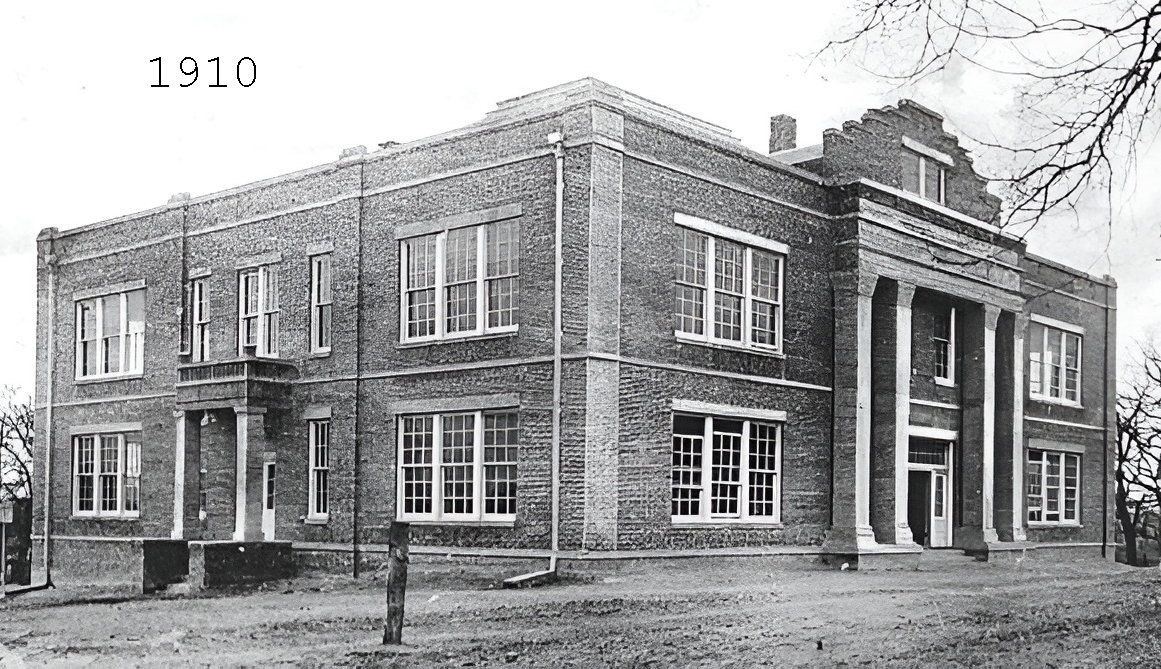
I posted photos of Mt. Vernon’s schools on Facebook a few years ago, and I professed ignorance regarding the long-vanished 1910 building. In a comment, Fannie Stretcher recalled being there December 8, 1941, the day after Japanese planes attacked our fleet at Pearl Harbor. Her fourth-grade class listened to the radio as FDR gave his famous “Day That Will Live in Infamy” speech. Further, Sue Stevens had attended elementary classes in that building and had seen it demolished in 1950.
Its former site became a school playground and, much later, what is now the aforementioned church parking lot. Some of you locals, as children, roughhoused on that unyielding grassless playground into the 1960s. Perhaps you suffered, as I did, cuts and scrapes from chips of brick and mortar left from the old building. Classmates and I made numerous visits to the principal’s office for swabs of Mercurochrome applied to our knees and elbows. We called the now-banned reddish disinfectant “monkey blood.” I remember its strong acrid-sweet smell.
I attended grades 1-8 in the 1928 building and, like Mrs. Stretcher, recall a national trauma: November 22, 1963, some classmates and I were playing outside to the south of the building when we heard an urgent, emotion-laden shout from the second-floor window of sixth-grade teacher Mathus Black’s homeroom. Called inside, we heard that President Kennedy and Governor Connally had been shot in Dallas.
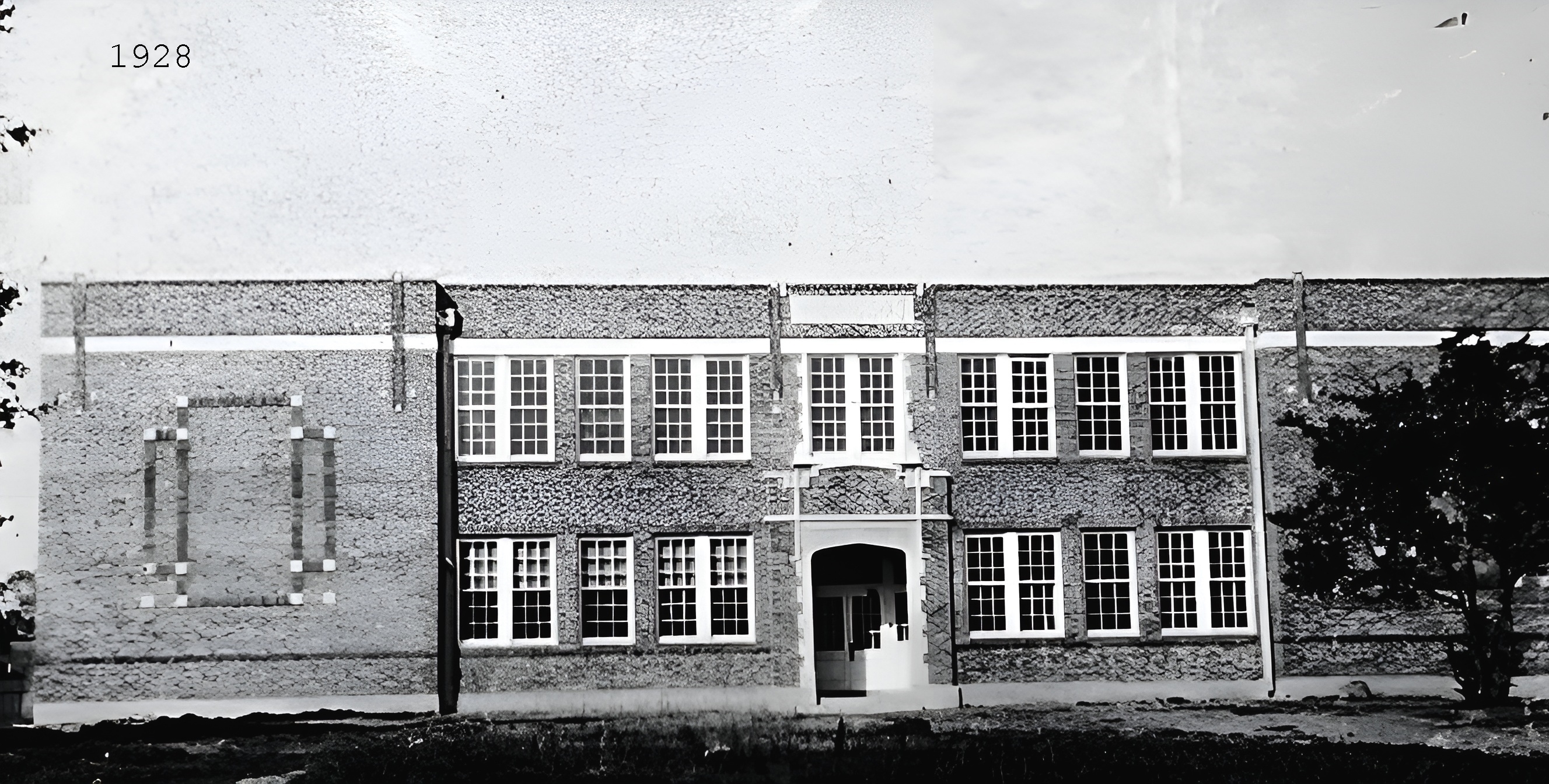
Well, the 1928 building was simply abandoned as the 1967-1968 school year began, and its students and teachers moved to the new campus on Highway 37. About five years later it suffered fire damage and was razed, with the exception of a free-standing cafeteria. Think of a Colonial home with the kitchen in an outbuilding to stop cooking fires from spreading to the house. This precaution left the cafeteria unattached and, in a reversal of architectural intent, saved it from fire. New owners made the cafeteria into a dwelling and built two new houses on the site.
Let’s return in time to another building. In a recent article, Ken Greer pictured the high school attended by Don Meredith. Following its construction in 1940, this successor high school left both 1910 and 1928 buildings to serve lower grades. Facing east on Holbrook Street, it boasted a multi-purpose gym with bleachers on one side and a stage on the other. Many of us older Mt. Vernon High School alumni still remember basketball games, PTA programs, Halloween carnivals, band performances, and other school and community assemblies there. A double-page spread in Meredith’s 1956 Tiger Annual shows the high school’s entire student body happily gathered out front. Though vacated in 1967 and now privately owned, the building is still standing.
For the 1967-1968 school year, new buildings spread out over the site on Highway 37 South and housed all grades. Over the nearly six decades since, the school district has added numerous facilities to a sprawling campus. Denson Construction Company’s full-page advertisement in the 1968 Tiger Annual featured a picture of the west facade of the new high school building. Accompanying the photograph were words that could have been spoken from the 1800s to the present day:
“We, the students of Mt. Vernon, wish to thank the townspeople for the foresight they have had in planning for these excellent facilities to further a better educational program for Franklin County.”
Notes to the Reader
Photographs with inset dates show three of the historic buildings:
Franklin Institute, 1893; New Brick School, 1910; and First High School, 1928.
This submission includes excerpts from Chapter 22 of the author’s book, Bottomland Credentials, available on Amazon.com.