Burn Ban in Effect. All outdoor burning is prohibited in Franklin County.



Imagine being a young man in 1959, standing at a crossroads in your life. You have been encouraged to pursue a career in medicine, but instead you make a decision that will change your life forever.
That young man was Jorge Otero Barreto, born April 7, 1937, in Vega Baja, Puerto Rico.
In 1959, he chose to join the United States Army.
He couldn't possibly have known then that his decision would eventually carry him through five tours in Southeast Asia, approximately 200 combat missions, and some of the fiercest fighting of the Vietnam War. He would become one of America's most highly decorated Vietnam veterans—and one of the most decorated Puerto Rican soldiers in American military history.
Otero Barreto was not an ordinary soldier.
In 1960, he became the first Puerto Rican soldier to graduate from the Army's Air Assault School. During his career, he served with some of America's most famous fighting formations, including the 101st Airborne Division, 82nd Airborne Division, 25th Infantry Division and 173rd Airborne Brigade.
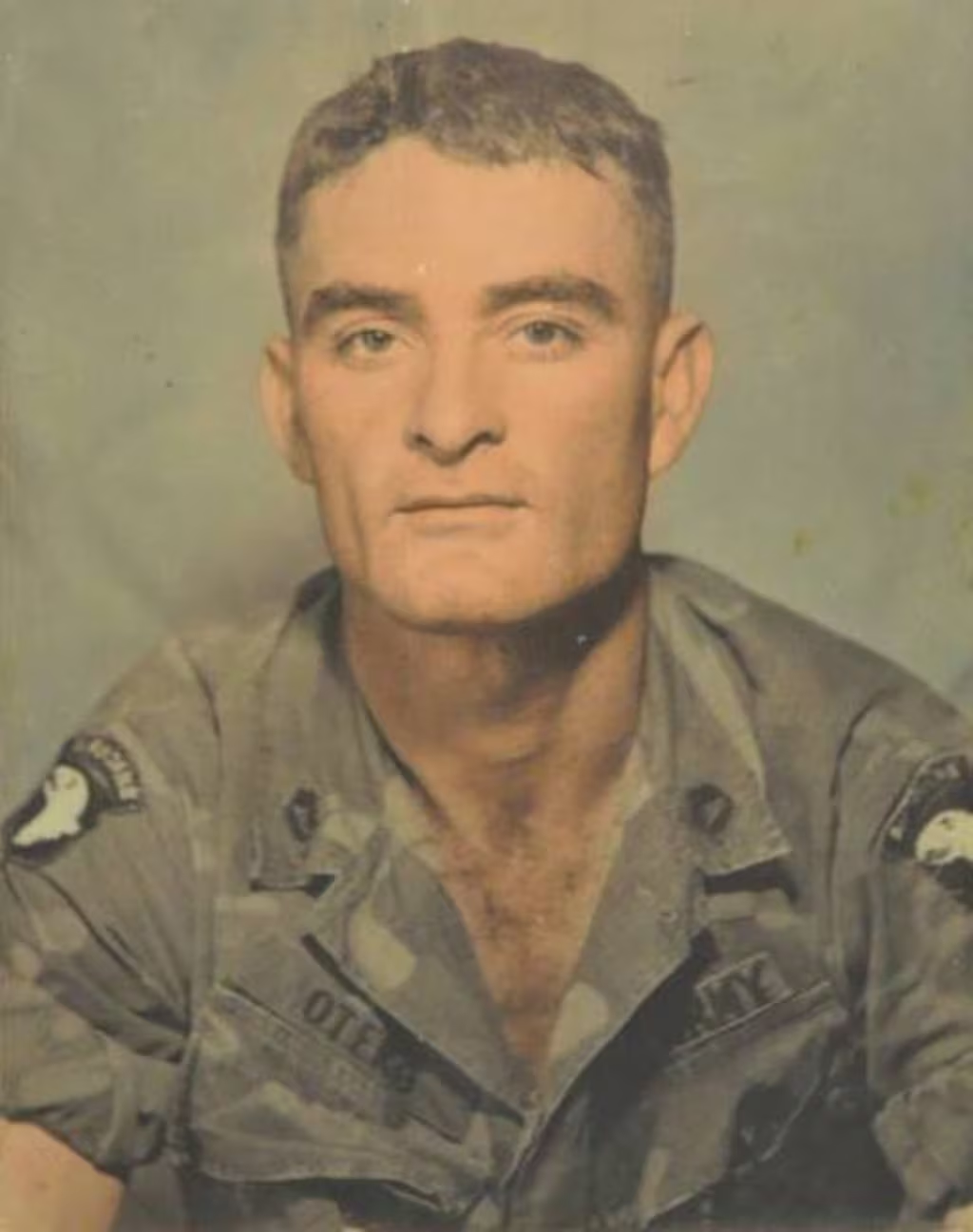
Then came Vietnam.
And there, Jorge Otero Barreto developed a reputation that followed him throughout the war.
His soldiers knew him as a man who led from the front.
In February of 1968, while serving with Company A, 1st Battalion, 502nd Infantry Regiment of the 101st Airborne Division, his unit was engaged in extremely heavy fighting near Hue City in the northern area of South Vietnam.
The situation became desperate.
His machine gunner was wounded, and his assistant gunner was killed. Otero Barreto didn't wait for somebody else to take over.
He picked up the machine gun himself.
With enemy forces attacking, he stayed behind to provide covering fire while his platoon withdrew. He continued firing until the ammunition was exhausted—and he was wounded during the fight.
For that extraordinary act of gallantry, he received the Silver Star.
But Jorge Otero Barreto wasn't finished.
Less than three months later, on May 1, 1968, he was back in combat.
Again near Hue, his company was defending positions around a village occupied by North Vietnamese forces. The enemy launched repeated attacks in an attempt to break through the American defensive line.
When the opportunity came to advance, Otero Barreto led his squad directly into the village.
He and his men moved against enemy defensive positions, neutralizing several of them. Then he positioned his squad so that they could provide covering fire while the rest of the company moved forward.
That action earned him a second Silver Star—formally presented as a Bronze Oak Leaf Cluster in lieu of a second award of the Silver Star.
And this is where his story becomes almost difficult to comprehend.
These were not isolated moments of bravery.
They were repeated acts of courage over years of combat.
Otero Barreto was wounded five separate times in Vietnam.
And after being wounded, he kept coming back.
The Department of Veterans Affairs reports that his military decorations included three Silver Stars, five Bronze Stars with Valor, five Purple Hearts, four Army Commendation Medals and five Air Medals. The University of Texas VOCES archive likewise records three Silver Stars and 38 military decorations.
And his combat service continued.
On December 3, 1968, Otero Barreto was serving with the reconnaissance platoon of Company E, 1st Battalion, 502nd Infantry Regiment, when he again distinguished himself in combat near Quảng Điền. He received a Bronze Star for Valor for that action.
Think about that for a moment.
A man who had already been wounded repeatedly, who had already earned Silver Stars for extraordinary heroism, continued to put himself in harm's way for the men serving beside him.
That is the part of Otero Barreto's story that I find most remarkable.
The medals are impressive.
The Silver Stars are impressive.
The Purple Hearts tell us that he paid a very real price.
But medals don't tell the whole story.
What they do tell us is that, time after time, when the situation became dangerous, Jorge Otero Barreto moved toward the danger rather than away from it.
His fellow soldiers came to know him by a nickname that followed him home:
"The Puerto Rican Rambo."
But there was a serious man behind that nickname.
After Vietnam, Otero Barreto continued serving veterans and his community. He became involved with the American Legion in Puerto Rico and spent years helping fellow veterans navigate the benefits and services they had earned.
And today, his name is still associated with efforts to recognize his extraordinary wartime service.
In fact, in July 2026, legislation was introduced in the United States House of Representatives—the Sergeant First Class Jorge Otero Barreto Medal of Honor Act—to authorize a posthumous Medal of Honor for his Vietnam service.
That effort says something important.
Jorge Otero Barreto's story is not simply about medals.
It is about duty.
It is about leadership.
It is about a soldier who repeatedly put his own life between his fellow Americans and the enemy.
And perhaps most importantly, it is about the price paid by those who served in Vietnam.
Jorge Otero Barreto went to war five times.
He flew and fought in approximately 200 combat missions.
He was wounded five times.
He earned dozens of military decorations, including multiple Silver Stars, Bronze Stars for Valor and Purple Hearts.
But behind every medal was a moment when another human being had to make a choice:
Do I stay here—or do I move forward?
Again and again, Jorge Otero Barreto moved forward.
That is why his name deserves to be remembered.
Not simply as the "Puerto Rican Rambo."
But as Sergeant First Class Jorge Otero Barreto—an American soldier who repeatedly demonstrated extraordinary courage under fire, and who devoted much of his life to the men and women with whom he served.
And that, ladies and gentlemen, is what military service is supposed to be about:
Duty. Courage. Sacrifice. And never leaving your fellow soldier behind.