Burn Ban in Effect. All outdoor burning is prohibited in Franklin County.



Photos courtesy of Ron Barker.
(This comes from my memories of living in the old Franklin County Jail while my Dad, John Ennis (Junior) Tittle was County Sheriff from 1950-1968. While the piece is enhanced throughout for effect, the plot for this tale of the attempted inmate suicide is true.)
Over time, I came to understand that the old Franklin County Jail, my boyhood home for 15 years, was an institute of higher learning for me. I learned many life-lessons there, and I had many instructors, but none taught me more, though, than Billie Jack, a drifter in his twenties on Highway 67, arrested one night by a state trooper outside of town. Most "suspicious characters" never stayed more than a couple days with us, but his stay lasted more than a month.
I could see him catching a lawman's eye, for sure, walking in the shadows at night along the highway, with a determined gait, head down, eyes fixed on a spot in the grass just in front of the toes of his boots. He wore a wide, flat-brim leather hat with a flat crown and a beaded native hat band, and his hair was long, pulled behind his head and tied to hang down his back; he carried a burlap sack slung over one shoulder. It turned out, Billie Jack had hitched rides, most in empty railroad freight cars, all the way from the Pine Ridge Indian Reservation in South Dakota, through the Rocky Mountains, into the Texas panhandle, and into the legal system in Mount Vernon, Texas.
My dad, Sheriff John Ennis (Junior) Tittle, had received word that a hold was placed on the wandering Indian; he was wanted in Colorado for burglary and theft, and he was a "person of interest" in several other crimes. Colorado Marshals would come for him; the Sheriff just did not know when.
Thus, over the coming weeks, Billie Jack would wander into my life as well. I remember him clearly to this day.
It didn't take the Indian drifter long to learn that I was the official "gofer," fully sanctioned by Sheriff Tittle to make cigarette and candy runs to the store, but his request was different; he had money for a sketchpad and a handful of charcoal pencils, which I found on the shelf at Crescent Drug Store across the town square. He had other sketchpads, full of his work, stuffed into the burlap sack, along with a toothbrush and one or two other personal effects. His talent was raw and powerful, and if I was helping with the inmates' feeding run at mealtime, he would take a few minutes to explain some of his sketches to me through the trap window in his locked door; slowly, a chronological portrait of his life took shape.

Looking back, my dad should have probably said, "I don't care if that door is locked; you're spending too much time up there. Cut it back." He didn't, though, and I was mesmerized by the mysterious loner, whose art had truly held up a mirror to life for me. He called the early sketches "life on the res..." meaning Indian land, even though there were rutted roads, old pickup trucks and trailer houses leaning awkwardly on concrete tile blocks. There was little, if any, resemblance to any traditional Native American life I had read about in school.
There were sketches of skinny stray dogs and abandoned dirt bikes and yards, worn thin from foot traffic and littered with scraps of windblown fast-food wrappers. Hopelessness hovered over these images like an ominous, heavy cloud
Another sketch found a reservation cop with braided pigtails and dark, aviator sunglasses, sitting in a rusty, early-fifties, primer-coated pickup, high on a bluff, staring off into nothing, POLICE stenciled in chipped, block letters on the door.
There were, however, sketches of Billie Jack, his brother and their grandfather, in happier times, fishing the streams for trout and hunting small game of some kind with a .22 rifle. And, there were sketches of the grandfather sitting with them under the stars, telling stories of native burial sites deep in the reservation, stories of the past, historically significant, before poverty took over and survival became dependent on some meager job in the town nearby, stories of life before government handouts and alcoholism and crime and quick cash and killing moved in.
There was a sketch of Billie Jack's mother, bruised and crying in a heap on the floor, her loser, drunk boyfriend towering over her with a scowl and clenched fists; and, then there was the sketch of the loser boyfriend, himself crumpled on the floor and bleeding, while in the distance, a young man with long hair and a leather hat ran toward town and the rail yard and the first empty boxcar, dragging a burlap sack stuffed with sketchpads and a toothbrush. There were no sketches of his father; he never mentioned him, and I didn't ask.
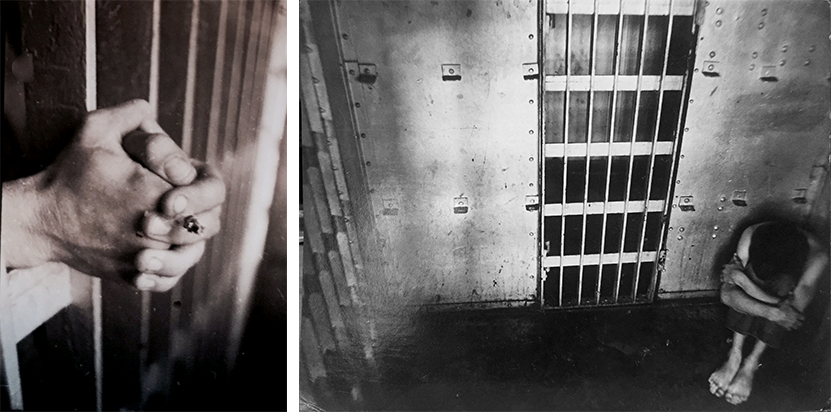
Billie Jack was content, it seemed, to spend his days now sketching this latest chapter in his life, waiting on Colorado Marshals and an uncertain future back there. Meanwhile, one weekend the jail population surged, unpredictably as always, and a hometown drunk found himself locked in the big room with the Indian. About three in the morning, the drunk woke us all, screaming blood-chilling cries for help while banging a tin drinking cup on the bars. The other prisoners in adjacent cells became vocal, as well, and restless.
When my dad burst into Billie Jack's locked room, he found him on his cot, blood oozing steadily from a self-inflicted cut in the big vein in his left arm, the drunk sobbing and mumbling nonsense in the room's corner shadows and Billie Jack chanting something foreign in a ceremonial tribal rhythm. He was clenching a bloody soda bottle cap he had flattened and rubbed sharp sometime in the past.
My dad cinched a necktie into a tourniquet and he and the ambulance driver strapped the Indian's bloody torso to a stretcher and hauled him down the steel stairs for the short ride to the Franklin County Hospital at the bottom of the hill. From there, he was taken somewhere, probably to a lock-down cell at Terrell State Hospital. My dad would never say; he would only tell me much later that the Indian was back in Colorado by now. I never saw him or his sketches again.
Billie Jack taught me about the power in art and about how fragile some relationships can be. His sketches would scream out that life is fickle, at best, and often played out on a slippery slope. Some Native American religions believe a hooting owl is a bad omen, a symbol of death and sadness. Anyone who hears the owl will be the next to die. Watching him through a locked steel door, I never saw any of this coming, but then, I believe that one night through an open, barred jailhouse window, Billie Jack must have heard the owl hoot three times in the distance. I just wonder whatever became of the South Dakota drifter.