Burn Ban in Effect. All outdoor burning is prohibited in Franklin County.



Aunt Ivey was the eldest of the four Hicks children born to John M. and Pauline Hicks. As Mt. Vernon High School’s 1925 valedictorian, she received a one-year scholarship to Mary Hardin Baylor in Belton. Then she taught rural schools for two years, intent on further college studies in the fall of 1927, at East Texas State Teachers College in Commerce. Her sister Fay John, having finished high school, planned to accompany Ivey.
Their younger brother Frank, my father, once told me he was lucky to finish high school. I knew this had to do with farming, but I didn’t fully understand until I read Fay John’s 2005 obituary. Written by her son, it included one particular story in her own words; as she was “sewing bloomers for college,” her mother Pauline entered the room:
“My mother came in, with dish and cloth in hands, saying, ‘You know, Fay John, I was just thinking, that if you could wait and enter school in January, Frank would not be taken from high school to help with the cane and syrup making.’ I said not a word, pushed my sewing to the end of the sewing leaf, got up, went to the shop, got a cane knife, and went to the cane field where Daddy was stripping cane.”
Frank’s help, along with that of the youngest sibling Nooney, would have been essential in dawn-to-dusk farming that fall. Knowing the story of Fay John’s sacrifice, I can appreciate Daddy’s lifelong devotion to her and his other sisters. It’s a Biblical principle: Substantial and life-altering sacrifice merits meaningful and lasting commitment.
After the delay, Ivey and Fay John shared an upstairs room in a Commerce boarding house in 1928; and together they faced hardships that presaged the ravages of the Great Depression. Ivey once visited with twin girls she’d met in a history class. The girls apologized for boxes of potatoes in the corner of their room: “We had to bring them from home. We just couldn’t survive here any other way.”
“You need not apologize to me,” Ivey said. “I have jars of canned sausages in my room, though I do have them stored out of sight in the highboy. My sister Fay John and I eat them with soda bread.”
Soda bread, an old Irish staple, consists of flour, salt, baking soda, and buttermilk. As for the sausages, Aunt Ivey told my brother Sid how home-butchered hogs’ meat was fried into patties and preserved in jars with hot lard poured on top. He says the process was sanitary: “The lard hardened and sealed the sausage patties that would be dug out later.” In the 1920s, otherwise, meat-packers were still struggling to overcome their portrayal in Upton Sinclair’s The Jungle, the book that led to the passage of the Pure Food and Drug Act of 1906.
The girls resided upstairs in a boarding house. One evening, Ivey came downstairs and skipped to the kitchen door, surprising four boys at their evening meal. The skinny male students ordinarily ate when no girls would be in the kitchen. My aunt recalled them blushing as if caught at a crime. “They were terribly embarrassed.”
One look at the table told Ivey the reason. Stoneware bowls of cornflakes, dowsed in red Poly Pop, announced their embarrassing poverty.
(Paul Hollis of Fort Worth invented Poly Pop, the world’s first powdered soft drink, in 1922. Its ingredients of citric acid, caffeine, color, and artificial flavor blended well with water and sugar.)
In the presence of a young woman, the young men stood but looked to the floor. Then a tall, sandy-haired boy smiled and looked at Ivey. He spoke with a resonant East Texas drawl: “I bet you never saw this combination before. We don’t have any milk.”
She laughed. “No, I’ve never seen that. But I guess Poly Pop beats nothing! I live mostly on soda bread and water myself. It makes me feel, at least, like I’ve almost had enough to eat.”
Ivey’s words, for a brief and fragile moment, broke the curse of misplaced shame, of not having “more.” One by one the boys shook off the spell, looked up, and examined that magical freckled face. In violation of house rules regarding shared spaces, they talked with her of families, hometowns, favorite teachers, and what their mothers would be feeding them if they were at home.
I once asked Aunt Ivey what students at East Texas State Teacher’s College did for entertainment in the 1920s.
“Of course, we walked everywhere,” she said. “Only one boy in the whole school had a car. His parents lived in Emory and were a little better off than most. It was the only student’s car ever parked on that whole campus while I was there. If we had dates, we just walked to downtown Commerce and window-shopped. Maybe the boy would have a nickel to spare for a couple of cream cones, and maybe not. But we were happy to live, to be friends, to talk, and to talk some more; for young people from different places, in those days, had much to say to one another.”
Notes to the Reader
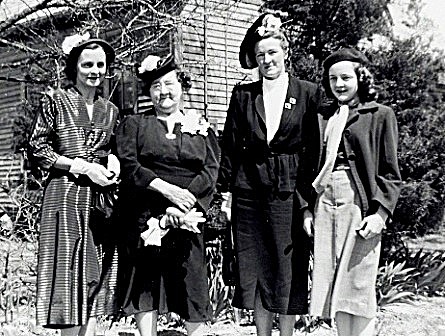
A photograph from the time of this story shows the sisters of my father, Frank Hicks, with their mother. Pictured left to right are Fay John, Pauline (my grandmother), Ivey, and Nooney.
This submission includes excerpts from Chapters 13 and 14 of the author’s book, Bottomland Credentials, available on Amazon.com.