Burn Ban in Effect. All outdoor burning is prohibited in Franklin County.



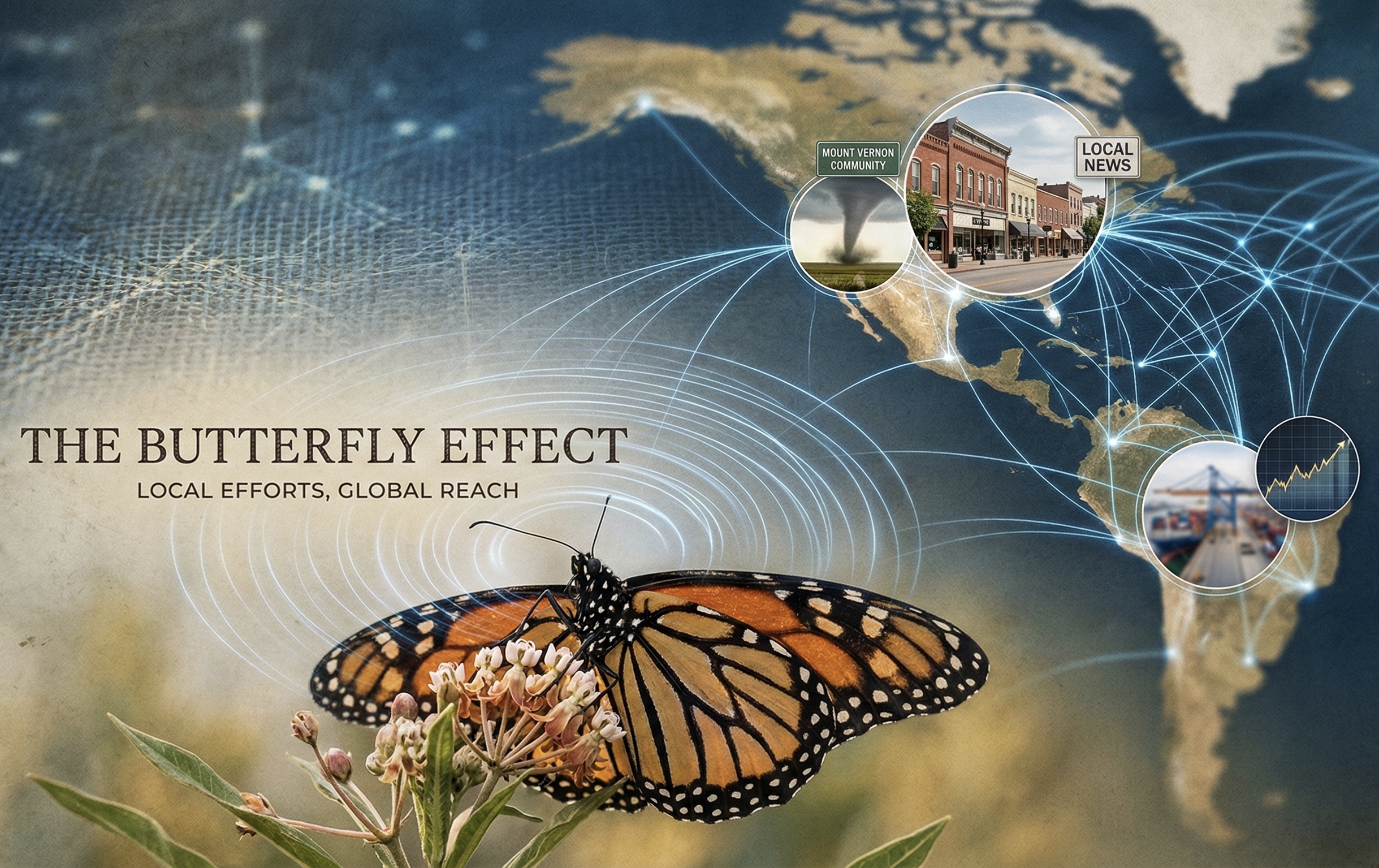
In 1969, MIT professor Edward Lorenz introduced the "butterfly effect," asking: “Does the flap of a butterfly’s wings in Brazil set off a tornado in Texas?” Eventually, this question became known as “Chaos Theory.” This suggests even small, distant actions may lead to big, unexpected results.
The butterfly effect, originating in Lorenz’s weather prediction research, revealed how tiny, distant actions can unpredictably shape large results. This principle, rooted in science, explains why forecasting weather or disease spread is difficult. But it also highlights a universal truth: complexity and unpredictability affect many parts of life, from economics to environmental science and traffic flow. Today, global events and technologies show that the butterfly effect is at work in Mount Vernon—distant occurrences can swiftly shape our economy and society.
This interconnectedness is reflected in many aspects of daily life. For example, changes in international oil prices can affect the cost of gasoline at local gas stations. Similarly, a drought in another country might raise prices for certain foods at Mount Vernon grocery stores. Natural disasters, political events, and global health issues frequently have economic or social effects that reach into communities far from where they began. Nature shows these connections, too. Monarch butterflies travel thousands of miles, needing healthy environments along the way. If habitats are lost, populations far away are affected, revealing how local areas fit into the larger natural system.
Consider the example of Monarch butterflies: Scientists track their populations to study how environmental alterations in one region can affect species across large distances. Conservationists emphasize the value of preserving habitats not only locally but also along migration routes, because disruptions in one area can have consequences far away. Citizens and organizations in Mount Vernon and elsewhere sometimes plant milkweed and other native plants to support these migrations, demonstrating how local efforts can contribute to wider environmental health. Even if it does not blatantly say so, local news reporting in North East Texas explains why world events matter here. Global journalism shows how distant changes affect our roads, jobs, and routines, helping us see which events truly impact our lives.
Local journalism often covers how international developments affect the Mount Vernon area. Examples include how tariffs on imported goods can affect prices for local businesses, or how global medical advisories can shape public health responses at the community level. By reporting on these topics, local news outlets provide the community with information to understand and respond to changes originating beyond our borders. Seeing the world this way shows how our town fits the bigger story and highlights our community's global connections.
Researchers and governments use the concept of interconnected systems to design solutions that account for local and global factors. For example, city planners in Mount Vernon may consider global climate trends when planning infrastructure, while public health officials coordinate with agencies at national and international levels to address community issues. These efforts highlight the importance of cooperation and information sharing across multiple levels of society.
Events across the world can influence daily life in Mount Vernon, just as our community’s actions—supporting conservation, healthy neighborhoods, or small businesses—create ripple effects that spread far beyond town borders. The butterfly effect illustrates how even individual choices here can lead to meaningful global impact. By supporting Mount Vernon's local habitat, residents demonstrate that local care can spark global wellbeing, reinforcing the main argument: small actions often have large, far-reaching results.
Sources
Hambling, D. (2019). Trump versus the weather. Fortean Times, (385), 14.
Dennis, E. B., Morgan, B. J. T., Brereton, T. M., Roy, D. B., & Fox, R. (2017). Using citizen science butterfly counts to predict species population trends. Conservation Biology, 31(6), 1350–1361. http://www.jstor.org/stable/44973674
Lecours, A., St-Hilaire, F., & Daneau, P. (2021). Fostering Mental Health at work: The butterfly effect of management behaviors. The International Journal of Human Resource Management, 33(13), 2744–2766. https://doi.org/10.1080/09585192.2021.1886151
Monarch butterfly. Texas Butterfly. (2020, April 11). https://texasbutterfly.com/2020/04/08/monarch-butterfly/
Western monarch population count underscores the need for endangered species listing. National Wildlife Federation Monarch Recovery Strategy. (2026, February 2). https://monarchs.nwf.org/
Zimmerman, J. B., Alvarez, P., Field, J., Lowry, G., Rosario-Ortiz, F., Schlenk, D., & Wang, P. (2023). The butterfly effect. Environmental Science & Technology, 57(48), 19065–19065. https://doi.org/10.1021/acs.est.3c09025