Burn Ban in Effect. All outdoor burning is prohibited in Franklin County.



Near dusk one August day in 1965, down the overgrown south bank of Carson’s Lake, my older cousin John Oliver led an expedition through underbrush and briars. My brother Sid and I brought up the rear. Our neighbor on East Main, David Gaulden, tramped along close on our cousin’s heels while narrating an imagined heroic quest. I felt relief when we broke into a clearing, but my cousin suddenly curtailed our trek. With one hand to his lips, he silenced David, and, with the other, he directed our eyes to oddly twitching sprigs of grass, which poked through an undulating, ankle-deep layer of fallen leaves.
Now, still, we heard an all-too-familiar swishing underneath that cover. And all at once, what seemed like dozens of scaly, snuff-colored snakes burst from their shelter and slithered away in all directions. The cottonmouth moccasin is venomous but, thank goodness, not aggressive. Somehow managing not to tread on a tail and trigger a bite, we all scrambled for higher ground.
Not even John Oliver told my father Frank Hicks, who’d brought us for a campout. No one wanted to miss the next day’s fun due to fear of snakes.
Let’s review some basics in economics.
According to his sister, Ivey Hicks Smith, my father made “his first hobo trip” in 1934. He would afterward travel the rails by freight car to construction jobs during the Great Depression, but this jaunt took him to Alabama for an unusual summer job on a relative’s farm: They were to plow up a lush but unharvested cotton crop.
Following the American financial collapse of 1929, a sudden loss of workers’ income and a continued excess in agricultural production combined to cause a disastrous collapse of prices for farm and ranch commodities. In 1933, elected officials resorted to a radical and undeniably destructive effort to reduce production. The Agricultural Adjustment Act compensated farmers for crops plowed under rather than harvested for market. In the South, one million farmers destroyed more than ten million acres of cotton alone.
This program saved many growers from looming bankruptcy and loss of property, and, as it removed excess supply from the market, it paved the road to an increase in commodity prices upon restoration of workers’ income and demand for goods.
In the late spring of 1933, the federal government began “emergency livestock reductions.” Millions of hogs and cattle were simply killed and buried in pits. Officials in Franklin County (population 3,400) boasted of that year’s cattle assessment at a value of $2,200,000. But Aunt Ivey remembered the shocking reality: “Cows were valued at $5 per head. You couldn’t have sold them for four bits. Ranchers didn’t refuse the federal government’s offer of $14 per head to kill them.”
But what happened to the burial pits and to the bones?
A few years after Daddy came back from Alabama, he and my grandfather went squirrel hunting in White Oak Bottom and came across, in Aunt Ivey’s words, “a scooped-up draw” parallel to the creek, two hundred feet long, twenty-five wide, and five feet deep in water, with many fish breaking the surface for air or bugs or both. Northeast Texas had experienced major flooding in 1938 and 1939. I suspect the creek’s overflow had washed away soft dirt to create the draw and leave fish trapped there.
The men took advantage of their surprising discovery and returned with a seine. Imagine a ten-foot-long, six-foot-wide net hung between two wooden poles, with lead weights fastened along its bottom and balsa-bead floats strung on top. Two men could drag it through the water, raising it at the feel of a large fish thrashing around in a bulge of the net.
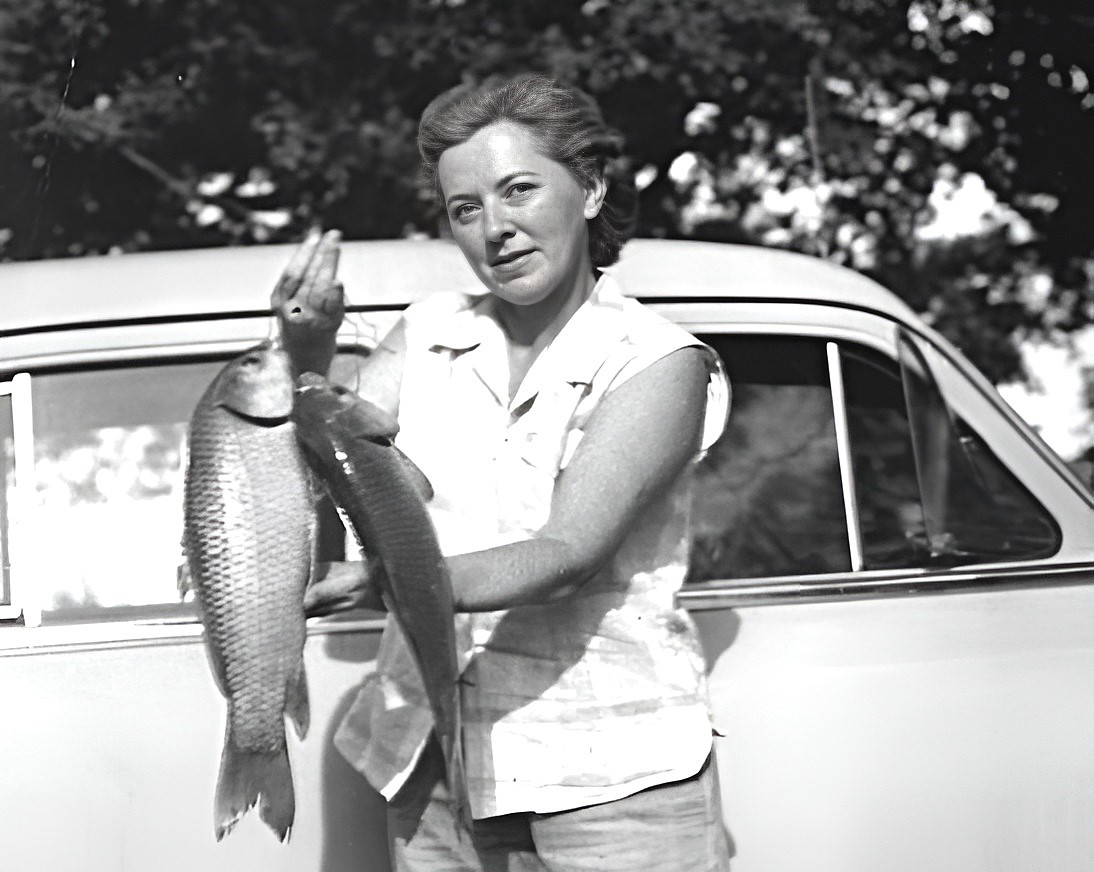
On their first excursion with the sein, they had great success with ancient river-fish varieties: buffalo, grindle, and gar. Small compared to the big graybeards found in large bodies of water, the youngsters were yet plentiful. Tasty buffalo were taken to be cleaned and frozen at home. Small but toothy gar, Daddy carefully removed from the net and threw it on the bank. The just-as-toothy but large and tasty grindle, he bagged and delivered to the homes of Black men who worked beside us in harvests at the Hicks farm or handed out to day laborers queued up at the Wagon Yard, just north of today’s Post Office. Most diners today would recoil from the hazardous web of feathery bones in the meat of both buffalo and grindle.
After their first time seining Carson’s Lake, Daddy and Granddad reported finding a number of large bones and skulls in the net with the fish. They had discovered a government cattle-kill site near the convergence of Franklin and Hopkins Counties, north of the old Hamilton Community.
So, two decades later, John Oliver and Daddy dragged a seine the length of that draw while David, Sid, and I waded close to shore with sacks to bag fish, always keeping an eye out for snakes on overhanging limbs. Below the surface, muddy water hid anything dangerous until it bumped you, like something in the dead of night reaching out from under the bed.
Filled in by muddy overflow and logging debris, Carson's Lake has long been lost to further expeditions. But, as watchful parents know, boys still like adventure.
A couple of years ago, in the hearing of my older brother, I told our friend John Tutor of nearly drowning on a wintry Saturday morning when I was ten years old. I stepped right through thin ice into a deep water-filled pit left from the excavation of a fuel tank on the northwest corner of South Kaufman’s intersection with the Cotton Belt Railroad tracks. When my head popped back up to the surface, two other boys held one hand of a courageous third as he reached out to clasp one of mine and pull me out. “I don’t remember that,” B.F. said.
Of course, he didn’t. The boys who’d dared me to test the ice and afterward saved me from drowning also feared discipline as administered in those days. Our parents had warned us to avoid such obvious hazards. We swore to secrecy. Back at home, I found the house empty, dried my clothes by the clay-back heater, and never told the tale. I suspect this will be, similarly, the first B.F. has heard of the snakes at Carson’s Lake. Boys will attempt the most dangerous of all dared things. Childhood friends and I prefer not to tell about them all.
This article is an excerpt from the author’s book, Bottomland Credentials.
The photograph, taken around 1950, shows the author's aunt, Pauline “Nooney” Hicks, holding two buffalo of the size caught by seining Carson’s Lake.